Quick answer
My child's dance shoes are giving them blisters
When she came home from Wednesday's jazz class with a quarter-sized blister on her right heel, the Bloch Pulse jazz shoes are 4 weeks old, and you cannot tell if you should size up or wait it out.
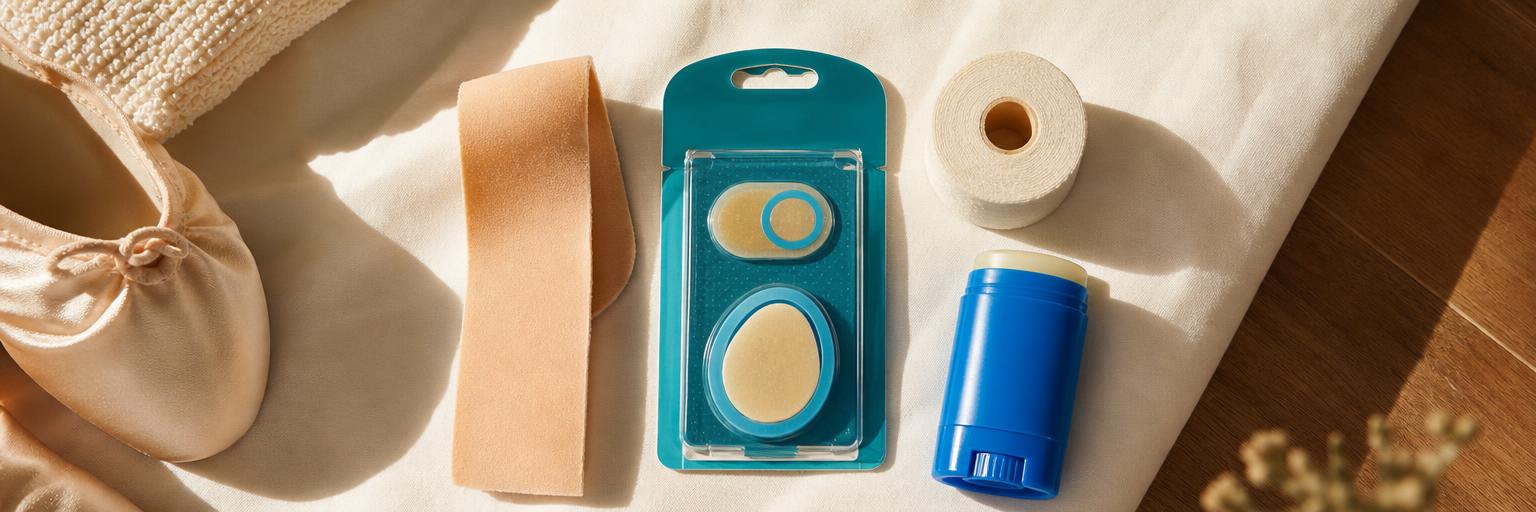
Quick read
Most dance shoe blisters come from one of three things: a shoe that's slightly too big (the foot slides and rubs), a shoe that hasn't broken in yet (new leather and canvas are stiff), or a specific pressure point from the way that shoe's last fits that dancer's foot. The blister location tells you which one. Heel blisters usually mean too big or not broken in. Toe blisters usually mean too small or too narrow. If blisters don't resolve after 3 to 4 classes, the fit needs a closer look.
Gear for this situation
What to do
- Check fit before blaming the shoe brand. Heel blisters usually mean the shoe is slightly too big: the foot slides on each step, and the edge of the heel cup creates friction. Toe blisters usually mean the shoe is too small or too narrow. The blister location is the diagnosis. A different brand with the same fit problem will produce the same blisters. When the rub sits at the ball of the foot or along the outer toes and a longer size has not fixed it, the shoe is too narrow rather than too small, and a wider-cut brand is the real fix: which dance shoes actually fit a wide foot names the jazz, tap, character, and ballet models that publish or run a wide width so you stop guessing brand by brand. Pair the blister-location map with the how do I know if my dance shoes fit correctly protocol, which reads fit by the four heel-and-toe telltales (slip on relevé, jammed toe curl, gapping over the top of the foot, drawstring overworked) so the diagnosis lands on what to actually do about it instead of just where the blister sits.
- If the shoe is new, check where you are in the break-in period. New leather ballet slippers, tap shoes, and jazz shoes are stiff and compress differently than a broken-in shoe. Most blisters from new leather shoes resolve on their own after 3 to 4 classes as the shoe flexes to the foot. Canvas ballet slippers break in faster: usually 1 to 2 classes. The break-in walkthrough covers the at-home break-in steps that shorten that window safely, plus the warning signs that mean the shoe is genuinely the wrong fit rather than just new.
- Catch it at the hot spot, before it becomes a blister. A blister starts as a warm, burning patch where the shoe rubs, and that early stage is the one you can actually stop. Teach the dancer to speak up the moment a spot starts to burn in class, then cover that exact spot with a strip of athletic tape or a swipe of anti-friction balm (the kind runners use) before the next class, so the shoe rubs against the tape instead of the skin. A hot spot handled early is gone by the next class. A blister left to form is a one to two week problem she ends up dancing around.
- Use Compeed blister bandages (not fabric bandages) during class while the blisters are healing. Compeed is the one bandage that stays on under tights and through class movement. Fabric bandages slide off on the first plie. Compeed is sold at most pharmacies and at competition venues.
- Know what to do with the blister itself, because popping the wrong one or peeling a torn one makes it hurt longer. An intact blister is best left alone. The dome of skin over it is a sterile, perfectly shaped bandage, so cushion it with a Compeed or a doughnut of moleskin and let it reabsorb rather than popping it for relief. If it is large, tight, and clearly going to burst from class anyway, a parent can drain it on purpose by cleaning the skin, sterilizing a needle with rubbing alcohol, pricking the very edge in one or two spots, pressing the fluid out, and leaving the roof of skin in place. Once a blister has already torn, do not pull the loose flap off, since the raw skin underneath hurts more and heals slower exposed. Trim only the ragged dead edges with clean small scissors, lay the flap back down, and cover it. Watch any open blister for spreading redness, warmth, pus, or red streaks up the foot, which mean infection and a doctor, not another class.
- If the blister is at the heel and the shoe is new: the break-in period should resolve it. Do not size down to stop the blister. If the shoe fits correctly by every other measure, wait through 3 to 4 classes before concluding the shoe is wrong.
- When the fit genuinely checks out, look at what is between the foot and the shoe, because a correctly sized shoe still blisters over a damp foot or a badly placed seam. Sweat is the accelerant, since a wet foot blisters far faster than a dry one, which is why a problem spot often shows up only in the warm second half of class. A thin moisture-wicking sock under a jazz or tap shoe, a light dusting of foot powder, or simply changing out soaked tights between numbers all help. The sneaky one is a seam. A footed or convertible tights seam, or a bunched sock, sitting right across the toes will rub a blister exactly where it lies, and that mimics a too-tight-shoe blister but disappears the moment you reposition the seam or switch to a smooth, flat-seam sock. So before you decide the shoe is the wrong size, rule out the layer touching the skin.
- If blisters do not resolve after 3 to 4 classes: go back to where you bought the shoe or take the shoe to a studio fitting session. Recurring blisters after break-in is complete mean the shoe's last does not fit that particular foot well, or the size needs a half-step adjustment.
- For pointe dancers with recurring toe blisters: this is a separate fitting and care conversation. A pointe shoe fitter can assess whether the issue is shoe shape, box depth, padding, or taping technique. The competition first-aid and foot care guide covers the basic pads and taping methods used backstage, and the what to bring to a first pointe-shoe fitting walkthrough lays out what the fitter will ask for and the questions to ask if the third box of shoes still rubs.
Common mistakes
- Don't use drugstore fabric bandages under tights. They slide off within minutes of class movement, bunch under the tights, and become a distraction. Compeed hydrocolloid bandages are the exception. They bond to skin and stay through class.
- Don't switch shoe brands to solve blisters without addressing fit first. A different brand will produce the same blister in the same location if the underlying fit issue is the same. Brand-switching delays the actual diagnosis.
- Don't break in shoes by wearing them at home for extended periods on carpet. Wearing dance shoes on carpet for hours stretches the sole without properly flexing the heel cup: the part most responsible for heel blisters. Short sessions on hard floors (kitchen, hardwood) with movement closer to class footwork are more effective.
- Don't treat recurring blisters as a normal part of dance. Blisters during the first few classes of a new shoe are expected. Blisters that appear every class on a pair that's been worn for a month signal a fit problem that will not resolve on its own.