Review

Dance Shoes for Wide Feet

Most dance shoes run in one width. It isn't 'medium' in any street-shoe sense. It's whatever that shoe was built to be, and you find out the hard way when the ball of your child's foot is pinching by the end of the first class. The most popular beginner tap shoe (Capezio Jr. Tyette) is documented narrow by Capezio right on the product page. One jazz shoe actually publishes width options: Narrow, Medium, Wide, X-Wide, and XX-Wide. That's the one we start with.

Updated 2026-06-10 · Independent research, editorial standards here

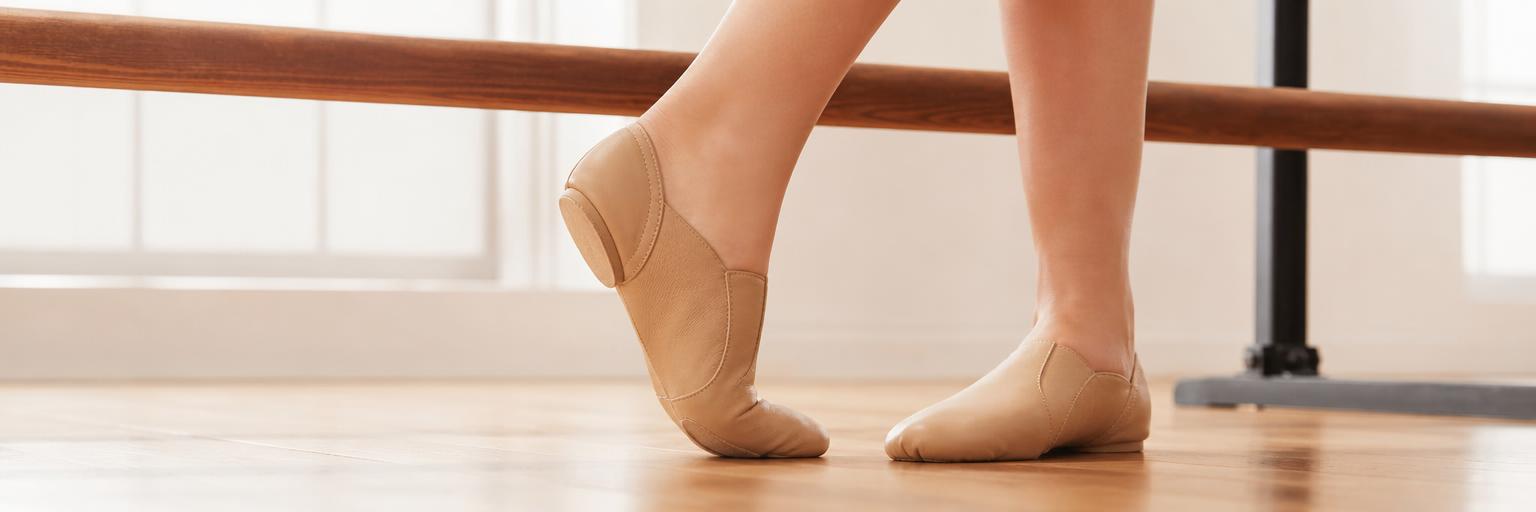
Close-up of a dancer's feet in properly fitting split-sole jazz shoes standing at a ballet barre.

Best Picks By Situation

  • Jazz class or competition, wide feet: So Danca JZ45. This is the pick precisely because it publishes actual width options. Order Medium or Wide before trying XX-Wide unless the foot measures notably wider than average.
  • Adult tap, wide feet, teacher-approved upgrade: So Danca TA20: Medium and Wide at DancewearCorner. Only order when the teacher has confirmed it is time to upgrade from a beginner shoe.
  • Child tap, wide feet, studio hasn't specified: Ask the studio before ordering. Capezio Jr. Tyette is narrow, but many studios specify it by name. You need the studio's permission to substitute before buying Bloch or So Danca instead.
  • Character shoes, first pair, wide feet: Order from DancewearCorner's character collection. They carry Bloch and So Danca alongside Capezio, all with exchange policies.
  • Ballet slippers, wide feet: Order from a dance retailer, use the specific brand's size chart, and expect the first pair to need exchange. The leather Bloch Dansoft and the stretch-canvas So Danca Bullet BA45 are worth trying before giving up; stretch canvas gives the most width forgiveness, and So Danca publishes the Bullet in a Wide width too (in pink or black only in larger adult sizes, about 9 to 12; the skin-tone shades carry Wide across the full adult range). The Bullet is split sole, so it suits a beginner only when the studio allows split sole.

Before You Buy

  • Identify whether width is actually the problem. A width issue pinches across the ball of the foot and outer toes. A length issue pushes toes into the front of the shoe. Ordering a bigger size solves a length problem, not a width problem.
  • Check the studio's dress code for brand requirements before substituting. Some studios specify Capezio or a particular style. You need the studio's sign-off before swapping to a wider brand.
  • Confirm the seller has an exchange policy before ordering. Final-sale items and marketplace sellers don't exchange. For wide feet, the exchange policy is not optional.
  • Use each brand's own size chart. Bloch, Capezio, and So Danca all size differently. A size that worked in one brand will not transfer to another.
  • So Danca JZ45 Tan colorway is final sale. Order Black or Caramel if you need the exchange option on a first fit.

Buying Strategy

The wide-foot problem in dance shoes is not really a shopping problem: it is a brand-selection problem. The fix is not to look harder for a wide-width section that doesn't exist on most dance shoe websites. The fix is to know which brands tend to run wider, which styles have explicit width options, and which sellers let you exchange the first pair when the fit is still wrong. So Danca JZ45 is the only jazz shoe that publishes actual width options. So Danca TA20 is the only adult tap shoe in its price tier with a published Wide option. Everything else is brand tendency and exchange policy. That's the whole strategy.

What We Would Do

For a wide-footed dancer who needs jazz shoes: order the So Danca JZ45 in Medium first, then exchange for Wide if Medium pinches at the ball of the foot. Don't jump to XX-Wide on the first order unless the foot is notably wide: most wide-footed dancers land in Wide, not XX-Wide. For adult tap: order the TA20 in Wide, same as street shoe or half size up (it runs small). For child tap: call the studio before ordering anything other than the Jr. Tyette. For character shoes and ballet slippers: use DancewearCorner as the retailer (exchange policy), try Bloch or So Danca as the brand, and use each brand's own size chart. Don't transfer any size from one brand to another.

Buyer Walkthrough

Start with the style and the width problem. If the shoe is pinching across the ball of the foot and outer toes on a fit that matches the length: that's a width issue. If the toes are hitting the front: that's a length issue. For a width issue, going up a size makes the shoe longer but not wider. The fix is to try a brand that tends to run wider for that style. For jazz shoes: So Danca JZ45, order the Medium width first. For adult tap: So Danca TA20 in Wide. For character shoes: go to DancewearCorner, try Bloch or So Danca before ordering Capezio. For ballet: try Bloch Dansoft with Bloch's size chart. In every case: order from a seller with an exchange policy, because the first fit on wide feet almost always needs one.

Mistakes To Avoid In Plain English

Don't order a size up to fix a width problem. A larger size gives more toe-box length, not more width at the ball of the foot. The shoe will be too long and the width pinch will still be there. Don't buy from a final-sale source or marketplace seller on a first fit for wide feet. If the width is still wrong, there is no exchange and you start over at full price. Don't transfer sizes between brands. Bloch, Capezio, and So Danca all size differently, and this is especially true for dancers who find one brand's last works for their foot shape. And don't skip the studio check before substituting a brand. Many studios specify Capezio Jr. Tyette by name for child tap. If your child needs a wider shoe, you need the studio's sign-off before buying Bloch or So Danca instead.

Where to start by buyer type

Situation

Jazz shoes, wide feet

The Pick

So Danca JZ45: the one jazz shoe that publishes width options, order Medium or Wide

Price

$50 (Black/Caramel); $25 Tan final sale

Check Before Buying

Tan is final sale. Order Black or Caramel for exchange safety net.

Check at So Danca
Situation

Tap child, wide feet

The Pick

Ask the studio before substituting: DancewearCorner tap section for Bloch or So Danca alternatives

Price

Varies by model

Check Before Buying

Many studios require Jr. Tyette by name. Confirm brand flexibility before ordering anything different.

Situation

Ballet slippers, wide feet

The Pick

Bloch Dansoft (leather) or So Danca Bullet BA45 (stretch canvas, offered in a Wide width): each brand has its own size chart

Price

~$15-22

Check Before Buying

Use Bloch's chart for Dansoft. Don't transfer Capezio sizing to Bloch or So Danca. The BA45 Wide is pink/black in larger adult sizes only and is split sole.

Picks at a glance

Current Shortlist

  • Jazz, wide feet: So Danca Janus JZ45 ($50 Black or Caramel, $25 Tan at final sale). The only jazz shoe that explicitly publishes width options: Narrow, Medium, Wide, X-Wide, and XX-Wide. If your dancer has wide feet and needs jazz shoes, this is the starting point. Order Black or Caramel if you need the exchange option on a first fit. The Tan colorway is $25 but final sale, no exchange.
  • Adult tap, wide feet: So Danca TA20 at DancewearCorner (~$70.20). Available in Medium and Wide, Adult 3-13. The only beginner-to-intermediate adult tap shoe in this price tier with a published Wide option at a dance retailer. Runs small: order same as street shoe or half size up.
  • Child tap, wide feet: the Capezio Jr. Tyette is the most common studio default, and it runs narrow per Capezio's own product page. Before switching brands, call the studio. Many studios require the Jr. Tyette by name. If the studio will accept an alternative, Bloch and So Danca child tap shoes tend to fit wider. Order from DancewearCorner for the exchange option.
  • Character shoes, wide feet: don't start with Capezio for wide feet. Bloch character shoes or So Danca character shoes tend to fit wider. Order from DancewearCorner for the exchange policy: first fits in character shoes for wide feet almost always need an exchange.
  • Ballet slippers, wide feet: the Capezio Daisy 205 is what everyone buys first, and Capezio does publish it in a Wide width (the size chart lists Narrow, Medium, and Wide). The catch is stock: at last check the Wide width was sold out brand-direct in every size, and most general dancewear retailers carry only the standard width, so the published Wide is hard to actually get. For a first fit on wide feet, the practical default is a slipper you can buy today with room to spare. Bloch Dansoft S0205 (~$22 brand-direct, leather) sits on a different last than Capezio and is a full sole, so it is the safe wide-feet pick for a beginner who needs full sole. The So Danca Bullet BA45 (~$15 in pink or black, stretch canvas) gives even more width forgiveness because stretch canvas conforms to the foot as it breaks in, and So Danca actually publishes it in a Wide width as well as Medium (in the standard pink and black the Wide runs only in larger adult sizes, roughly 9 to 12, so it does not help a small child). The catch is the sole: So Danca classifies the Bullet as split sole, so only reach for it if the studio allows split sole. Don't transfer Capezio sizing to Bloch or So Danca: the charts produce different results from the same foot measurement.
  • One rule that covers every style: order from a seller with a free first-pair exchange. Width isn't labeled on most dance shoes. You're making your best guess, and a non-returnable first purchase on wide feet is expensive when the guess is wrong.

How To Choose

  • Check where the shoe feels tight. A width problem pinches across the ball of the foot and the outer toes. A length problem pushes the toes into the front. If the front feels okay but the sides pinch across the widest part of the foot, that is a width issue, not a sizing issue. A size larger gives more length, not more width.
  • Tight across the top of the foot is a different problem from tight across the ball. A high instep, the height of the foot from the sole up to the top of the arch, makes a shoe feel like it is clamping down over the laces or the throat of the slipper even when the ball has room to spare. A wider shoe will not fix this, because width is measured across the ball, not over the top. What fixes a high instep is an adjustable closure: a lace-up oxford (jazz, tap, character) you can ease off over the instep, or a ballet slipper whose drawstring and elastic can be reset to sit looser across the top. A slip-on or single-strap shoe with no give over the instep is the one to avoid on a high-volume foot. If the shoe pinches the sides and clamps the top, you have a wide high-volume foot, so reach for a wider-cut brand in a laced or drawstring style and solve both at once.
  • A wide ball riding on a narrow heel is its own foot, not a sizing mistake. Plenty of wide-footed dancers are only wide up front: the shoe fits across the ball but the heel gaps and pistons up and down on a rise. The instinct is to size down or grab a narrower shoe to catch the heel, and that just re-pinches the ball you finally got right, so fix the heel at the heel and leave the width alone. On a ballet slipper this is exactly what the drawstring is for: gather it to snug the throat and heel without touching the ball, which is one more reason a drawstring slipper beats a loose pre-elasticized one on this foot. On a lace-up (jazz, tap, character oxford) use heel-lock lacing, the trick of running the lace up through the last eyelet on its own side to make a small loop, then crossing each lace through the opposite loop and pulling, which cinches the ankle and locks the heel down without tightening across the ball. If it still slips after that, a self-adhesive suede or gel heel grip at about $5 takes up the last bit in any style, and it is the cheapest fix on this whole page.
  • Brand tendency as a starting point: Capezio tends to run narrower across most styles. Bloch and So Danca tend to run wider than Capezio, though this varies by specific model. Brand tendency is a reasonable starting filter when you don't have a model-specific width guide.
  • The one exception: the So Danca JZ45 jazz shoe actually publishes Narrow, Medium, Wide, X-Wide, and XX-Wide options. This is rare in dance shoes. For jazz specifically, order the width that matches the foot: that's more accurate than guessing from brand tendencies.
  • If the studio specifies a brand: call the studio before substituting. Many studios require specific brands or styles that may not offer wide options. A different brand for wider feet still needs to meet the dress code. Some studios can recommend width-friendly options within their requirements.
  • When the studio locks you into a single-width shoe, leather can be stretched. If the required brand pinches across the ball and you cannot substitute, a leather upper (most jazz, character, and tap shoes) will give. A cobbler can stretch the ball area, or a two-way shoe stretcher at about $15 does it at home over a day or two. Canvas and stretch-canvas conform on their own as they break in. Satin and pointe shoes will not stretch, so for those the width has to be right at purchase. Stretching buys roughly a half-width, so it rescues a near-miss, not a shoe that is genuinely too narrow.
  • Seller exchange policy is part of the purchase decision. For wide-footed dancers trying a new brand or style, order from a retailer (DancewearCorner, Capezio direct, So Danca direct) where exchanges are standard, not from marketplace sellers or final-sale sources.

Avoid If

  • Capezio Jr. Tyette as the first purchase for a wide-footed child. It's the most common beginner tap shoe, and Capezio says right on the product page that it runs narrow. If the studio requires it by name (many do), call the studio first: you may need permission to substitute before trying an alternative.
  • Any non-returnable or final-sale purchase for a first-time fit on wide feet. Even from a brand that tends to run wider, the first fit needs an exchange path. Final sale means no option if the width is still wrong.
  • Assuming sizing up solves a width problem. A half size larger gives more toe-box length, not more width at the ball of the foot. Ordering a size too large to compensate for width creates a different fit problem: heel slippage and poor technique feedback.

How To Tell It's Width, Not Length, On A Kid Who Can't Tell You

Every fit check that asks where the shoe pinches assumes a dancer who can answer. A four-year-old can't, and she'll dance on a too-narrow shoe all class without a word. Here is how I read it off her foot instead of waiting for her to complain.

  • Trace the foot before you order. Stand her on a piece of paper with full weight on it, hold the pencil straight up, and trace tight around the foot. Do both feet late in the day when feet are at their widest. Measure the length and the widest part across the ball, then check both against that brand's own size chart, not a generic one. A foot that is average length but lands a full size wider at the ball is the foot every single-width shoe will pinch.
  • Fit the wider foot, never the average of the two. Almost every kid has one foot wider than the other. Size to the wider one and let the smaller foot ride a touch roomy. Splitting the difference guarantees one shoe pinches.
  • Use the bulge test once it's on. With the shoe on and the child standing, run your thumb along the side seam at the ball of the foot. If the upper bulges out past the edge of the sole, or there's no slack to pinch anywhere along that seam, it's too narrow no matter how the length looks.
  • Read the red marks after class. Pull the shoe and the sock and look at the bare foot. Width problems leave red lines down the side of the foot at the ball and over the pinky-toe knuckle. Length problems redden the very tips of the toes or leave them curled. The marks tell you what to fix without her saying a word.
  • Confirm wiggle without heel slip. In a shoe that's wide enough, her toes can spread and wiggle but the heel stays put when she rises to demi-pointe. If you went up a size chasing width and now the heel pops out on a rise, you've traded a width problem for a worse one, and that's the cue to fix width by width (a published wide option, a wider brand, or stretching) instead of by length.

By Style: Width Starting Points

Most dance shoes don't label their width. Use these starting points to narrow your first attempt.

StyleTry First (tends wider)Narrower-Fitting DefaultWidth Note
Jazz shoesSo Danca JZ45 (explicit N/M/W/XW/XXW options published)Capezio Fierce DS11 (tends narrow)JZ45 is the only jazz shoe that publishes width options. All others are single-width.
Tap shoes, adultSo Danca TA20 (Medium and Wide at DancewearCorner)Capezio Jr. Tyette (runs narrow, Capezio confirms)TA20 Adult 3-13 M/W. Tyette is child sizing and documented narrow.
Tap shoes, childBloch or So Danca tap via DancewearCornerCapezio Jr. Tyette (narrow, Capezio confirms on product page)Ask studio for brand flexibility before ordering anything other than the default.
Character shoesBloch character collection, So Danca character collectionCapezio character shoes (Footlight in particular)Try from DancewearCorner for exchange policy. Width varies by specific model within each brand.
Ballet slippersBloch Dansoft S0205 (leather, full sole)Capezio Daisy 205 (Wide width published but routinely out of stock)All ballet slippers run narrow relative to street shoes. The So Danca Bullet BA45 (stretch canvas) gives the most width forgiveness and is one of the few ballet flats published in a Wide width (in pink or black only in larger adult sizes, about 9 to 12; the skin-tone shades carry Wide across the full adult range), but it is split sole, so only when the studio allows it. Use each brand's own size chart.
Dance sneakersBloch Boost Mesh, So Danca DK-seriesCapezio Fierce DS11 (tends narrow)Dance sneakers vary significantly by model. Check product-page width notes before ordering.

Keep reading

More reviews worth your time