Quick answer
What shoes do I need for lyrical and contemporary dance
When the studio just added lyrical to her Wednesday schedule, the teacher's email says 'we will start in bare feet but you may want half-soles eventually,' and you do not know if that means buy now or wait.
Quick read
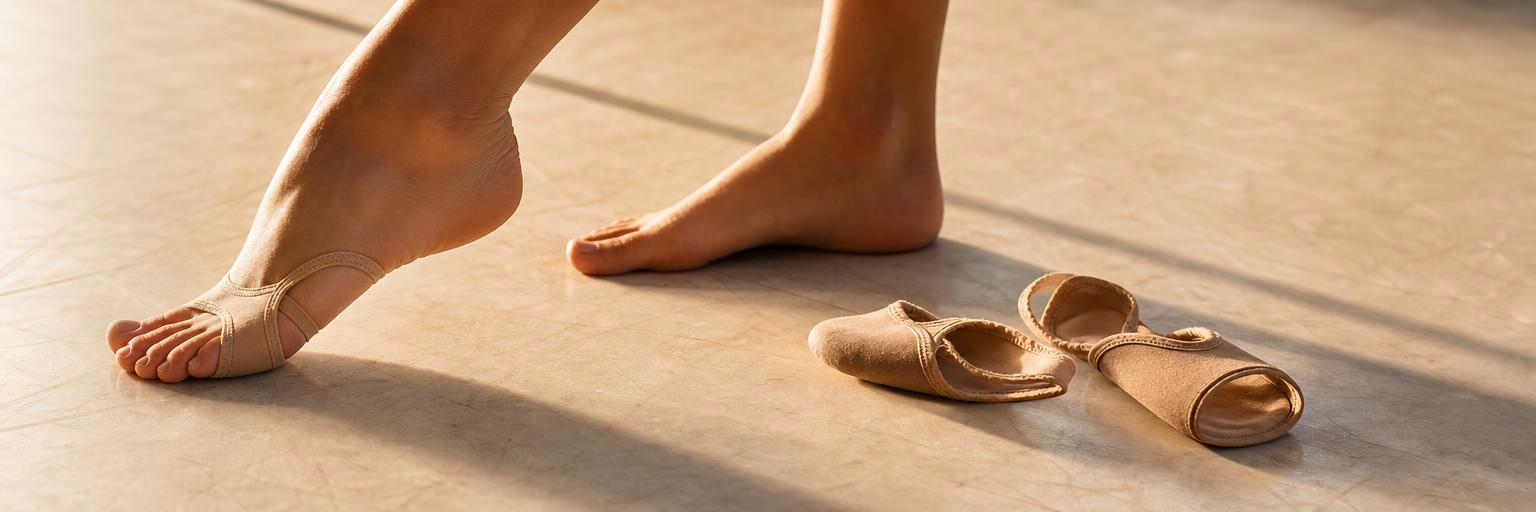
Ask the teacher first, because lyrical and contemporary split three ways: some want bare feet, some a fabric half-sole (a foot thong that covers just the ball of the foot), some a split-sole jazz shoe. There is no single standard, so if you cannot reach her before the first class, default to bare feet, the safe no-purchase fallback. The reason teachers land where they do is the grip-versus-skin tradeoff: bare skin grips a marley floor hard, so a turn-heavy or floor-heavy class catches and burns the skin, and a half-sole fixes both at once by letting the ball of the foot pivot while shielding it on slides. If she wants a half-sole, the studio default is the Capezio FootUndeez (about $28.50, sized by street shoe size, not S/M/L), and for a genuinely deep skin match Blendz Apparel keeps deep shades brand-direct. Match the half-sole to her own skin the way you would her tights, since a pad two shades off is exactly what a judge's eye catches on stage.
Gear for this situation
What to do
- Ask the teacher before buying anything. Lyrical and contemporary teachers have very different shoe preferences: some want bare feet, some want jazz shoes, some want half-soles. There is no single standard the way there is for tap or ballet. The one question to ask: does your teacher want bare feet, half-soles, or jazz shoes for this class? If she has not answered by 48 hours before class and you are out of time to wait, default to bare feet for the first class. Bare feet is the safest no-purchase fallback (no wrong shoe to walk in with, no money spent), and the teacher will tell her in person on day one what she wants going forward.
- If the teacher recommends half-soles (also called foot thongs): these are fabric pads that cover the ball of the foot and grip the floor, leaving the heel bare, so they protect the skin on turns and slides without covering the arch or blocking barefoot feel. The studio default is the Capezio H07 FootUndeez (about $28.50, or $22.80 on the Espresso shade when it is in stock), a fabric half-sole stocked nearly everywhere. It sizes by street shoe size (P through XXL on Capezio's chart, round a half size up to the next full size), not by S/M/L, and it should sit snug at the ball with no sliding. For a genuinely deep skin match, Blendz Apparel keeps four deep shades brand-direct ($26 canvas, $29 leather). The foot undies and half soles guide has the full picks and the shade map.
- If she lands on half-soles, buy two pairs from the start and keep the spare in her dance bag. Half-soles are the easiest piece of dance gear to lose: they are tiny, they slip off when she changes, and the toe loop or heel elastic is the part that gives out first, not the pad itself. A loop that has stretched loose slides mid-turn, and a half-sole that walked off in someone else's bag the week of a competition is a real backstage scramble, because almost no drugstore carries them. At ten to eighteen dollars a pair the backup is cheap insurance, and buying both at once means the spare is the same size and brand the day you reach for it. Retire a pair the moment the elastic stops holding, since a half-sole that will not stay put is worse than going bare.
- If the teacher recommends jazz shoes for lyrical: split-sole canvas is the most common choice. Split sole gives the foot flexibility at the arch, which lyrical technique uses. Match the color to the class requirement (usually tan or black). The jazz shoes guide has current picks: Best Jazz Shoes for Class and Competition.
- If the teacher says bare feet are fine: start bare and see how the floor feels. Many lyrical and contemporary students work barefoot for months before adding half-soles. Adding footwear before you need it changes how your feet feel the floor and can actually slow down floor-work development for new dancers.
- Understand the grip-versus-skin tradeoff, because it is the real reason teachers land on bare feet, half-soles, or jazz shoes. Bare feet give the most connection to the floor, but bare skin grips a marley surface hard, so turns can catch and fast slides can leave friction burns on the ball of the foot, the toes, and the tops of the feet. Half-soles fix both at once. The smooth pad lets the foot pivot and release through a turn, and it shields the skin that drags on a slide, which is why a teacher who choreographs a lot of turning and floor work tends to require them. If your dancer is fighting her turns barefoot or coming home with raw spots after class, that is the signal to ask about half-soles, not a sign she is doing something wrong.
- Check whether the class has a recital. If there is a recital, the costume sheet will specify the exact shoe. Don't buy footwear until you have it. Lyrical recitals sometimes require a specific flesh/nude color, a split-sole jazz shoe in a particular brand, or a style that pairs with the costume. Buying before the spec exists usually means buying again.
- If the goal is a competition solo or a contemporary piece on stage, the look usually decides the foot, and the convention leans bare. Judges in lyrical and contemporary read the line of the foot, the arch and the point, so most competition routines are danced barefoot or in a nude half-sole that all but disappears under stage lights. The Capezio FootUndeez in a skin tone is the common pick here, because it shields the ball of the foot for slides and turns while still reading as bare from the audience. A tan or black jazz shoe is fine for class but tends to look heavier on a competition stage, so before you buy for a solo, ask the choreographer what she wants the feet to look like, not only what protects them. Match the half-sole to your dancer's own skin the way you would her tights, since a pad two shades off is exactly the thing a judge's eye catches. Our foot undies and half soles guide maps where the deeper skin-tone shades actually live, since Capezio's own Espresso is the deepest mainstream shade and is routinely sold out, while Blendz Apparel keeps four genuinely deep shades brand-direct.
- If your class is actually hip-hop, jazz funk, or another street style rather than lyrical or contemporary, this article does not cover those. Hip-hop class almost always requires a sneaker with a non-marking sole, and the wrong call between styles is the most common day-one shoe mistake in studios that offer all three. If you're not sure which category yours is, ask the teacher to name the style on the schedule, since some studios use 'contemporary' as an umbrella that includes lyrical and modern, while others split them into separate classes. The Dance Sneakers guide covers the hip-hop side.
Common mistakes
- Don't buy dance sneakers for lyrical or contemporary unless the teacher specifically asks for them. Dance sneakers are for hip-hop and street styles. A split-sole jazz shoe, half-sole, or bare feet is standard for lyrical. Sneakers look wrong and feel clunky for that style's floor work.
- Don't buy jazz shoes before confirming the color requirement. Black and tan are both common for lyrical class. If the class has a recital, the costume sheet will specify. Buying the wrong color means buying twice.
- Don't buy half-soles that are too large. A half-sole should sit snug at the ball of the foot, and too big means it slides during turns and floor work. Use the brand's own size chart, not a guess: the Capezio FootUndeez sizes by street shoe size (round a half size up to the next full size), while some fabric thongs run S/M/L, so read the chart for the exact pair you are buying.
- Don't assume your child's class is lyrical when it might be hip-hop or street contemporary. If the class is in a studio that does hip-hop or urban styles, the shoe requirement is different. Ask the teacher to confirm the style before shopping anything.