Picks at a glance
Price$47.00 direct, the same at every size, verified 2026-08-02
Why it winsFull-grain leather that softens to the foot instead of staying stiff, and one flat price at every size, so an adult pair does not cost more than a child's.
Where it falls shortIt laces. If your dress code says slip-on, this is the wrong shoe no matter how well it fits.
Check before buyingBloch direct does not do exchanges and anything discounted more than 20% is final sale. Order a size you have actually measured, or buy it from a retailer that takes returns.
Check at Bloch →Price$52.00 adult, child sizes from $41.60, verified 2026-08-02
Why it winsSlip-on, so it clears the dress codes the lace-up Bloch fails, and medium and wide come off the same page. Child sizes start under $42.
Where it falls shortSizing is the part people get wrong. Capezio runs its own chart and the gap from street size is wider here than in either other brand on this list.
Check before buyingEvery adult size and width was in stock at check time. Capezio jazz sizing does not track street size, so order from Capezio's own chart rather than from her sneaker size.
Check at Capezio →Price$50.00 for nearly every size, with a small marked-down run at $24.00, verified 2026-08-02
Why it winsFive widths from narrow to XX-wide, which almost nothing else in jazz offers, and sizing that tracks street size for children and women instead of fighting it.
Where it falls shortFull sole, so if the studio wants the split-sole look this is not it. The marked-down run covers only a few sizes, so the $24.00 you spotted is probably not the size you need.
Check before buyingAll 195 size, width, and color combinations were in stock at check time. So Danca returns want shelf-ready condition: clean soles, original packaging.
Check at So Danca →Which one for your dancer
- Studio dress code is specific: buy exactly what's listed: color, material, sole type, slip-on or lace-up. Don't substitute because something else is cheaper.
- Adult dancer or hard-to-fit foot: width and heel-slip beat brand prestige. So Danca Janus for wide feet. Bloch Jazzsoft for laces-and-adjustability. Capezio E-Series if Bloch doesn't fit.
- Replacing a shoe before a recital or competition: pick in-stock + fast shipping + a return policy you trust. A discount on a shoe that arrives Friday for Saturday's competition is not a deal.
- Building a comparison list: Bloch, Capezio, So Danca, and (carefully) Sansha and Theatricals. Skip Very Fine entirely. It's a ballroom shoe, not a jazz shoe.
Before you buy
- Read the costume sheet or dress code: black, tan, or nude? Leather or canvas? Split sole or full sole? Slip-on or lace-up? Most jazz-shoe mistakes start by skipping one of these.
- Try the shoes on carpet only until you know the size is right. First step on a hard floor marks the sole. Marked sole = no return at most sellers.
- Check the seller's return rules on dance footwear specifically. Some treat marked soles as worn. Some charge restocking fees. Some won't exchange at all.
- Don't substitute a jazz sneaker when the rule says jazz shoe. Same word ('jazz'), totally different product.
How to approach it
Your dancer will not wear the same size in a Bloch Jazzsoft as she does in a Capezio Freeform, and nothing on either product photo tells you that. So the buying strategy is: studio rule first (color, material, split-sole vs full-sole, slip-on vs lace-up), fit second (width, arch, heel slip), seller policy third. A jazz shoe that slips at the heel, squeezes the forefoot, or can't be returned after a clean indoor try-on is not a bargain. Even at $20.
What we would do
For a studio with a specific shoe rule, we'd buy exactly what's listed: Bloch Jazzsoft if the rule says Bloch, Capezio E-Series if the rule says Capezio. For an adult or hard-to-fit dancer, we'd start with So Danca Janus (XX-wide is rare) or Bloch Jazzsoft (laces help) from a seller that takes returns. For a replacement pair the week before a recital, we'd skip the cheapest option and pay for in-stock + reliable shipping: a late shoe costs more than a $10 discount. Bloch, Capezio, So Danca, Sansha, and Theatricals all belong in the comparison, but none of them beat the studio rule.
How to work out which one
Pull up the studio dress code. Write down: color, material, sole type (split or full), slip-on vs lace-up, and any specified brand or model. Once you have that, check the fit. A jazz shoe should hold the heel, let the arch move, and not squeeze the forefoot. If your dancer is adult, wide-footed, or between sizes, a seller's return policy matters more than the lowest price. The shoe you order from a forgiving retailer is the shoe you can actually fit-test at home.
Mistakes to avoid
Don't substitute canvas for leather, black for tan, or a sneaker for a jazz shoe unless your teacher signed off in writing. Don't mark the soles before the size is confirmed: first step on hardwood ends the return. Don't assume Bloch sizing carries over to Capezio or So Danca; the same dancer often wears different sizes in each brand. And don't trust 'jazz shoes fit like street shoes' from anyone. The Capezio Freeform alone has Capezio telling women to add 1.5 sizes while specialty fitters size it down, a two-size spread that proves the point: order to the product page and the brand chart, not your street size.
Where to start
| Best For | Start Here | Why | Check First |
|---|
| Studio has a specific rule | Buy the exact required jazz shoe: same color, material, sole type, and slip-on/lace-up style | A cheaper shoe that breaks the studio rule still gets sent home. Buy what they asked for. | Color wording, leather vs canvas, split vs full sole, and whether laces are accepted on stage. |
| Adult dancer or wide foot or between sizes | Try So Danca Janus or Bloch Jazzsoft from a returnable seller | Width and adjustability matter more than brand prestige for hard-to-fit feet. Test on carpet only. | Return rules after clean indoor try-on. Whether marked soles void the return (they usually do). |
| Replacing a shoe before a recital or competition | An in-stock specialist retailer (Discount Dance or DanceWear Corner) or direct brand route with explicit delivery dates | A late shoe is worse than a slightly more expensive shoe. | Delivery date confirmation, final-sale language, and that the model still meets your studio's exact rule. |
The shortlist
- Need a default that fits most studios? Bloch Super Jazz or Neo-Flex vs Capezio E-Series. These are the two shoes most studio dress codes assume anyone already owns. Pick one of them unless your studio specifies otherwise.
- Competing and want the cleanest foot line on stage? Bloch Pulse or Bloch Spark. Split-sole, stretch/neoprene construction. Beautiful on stage. Fit is personal. Try before you commit to final-sale.
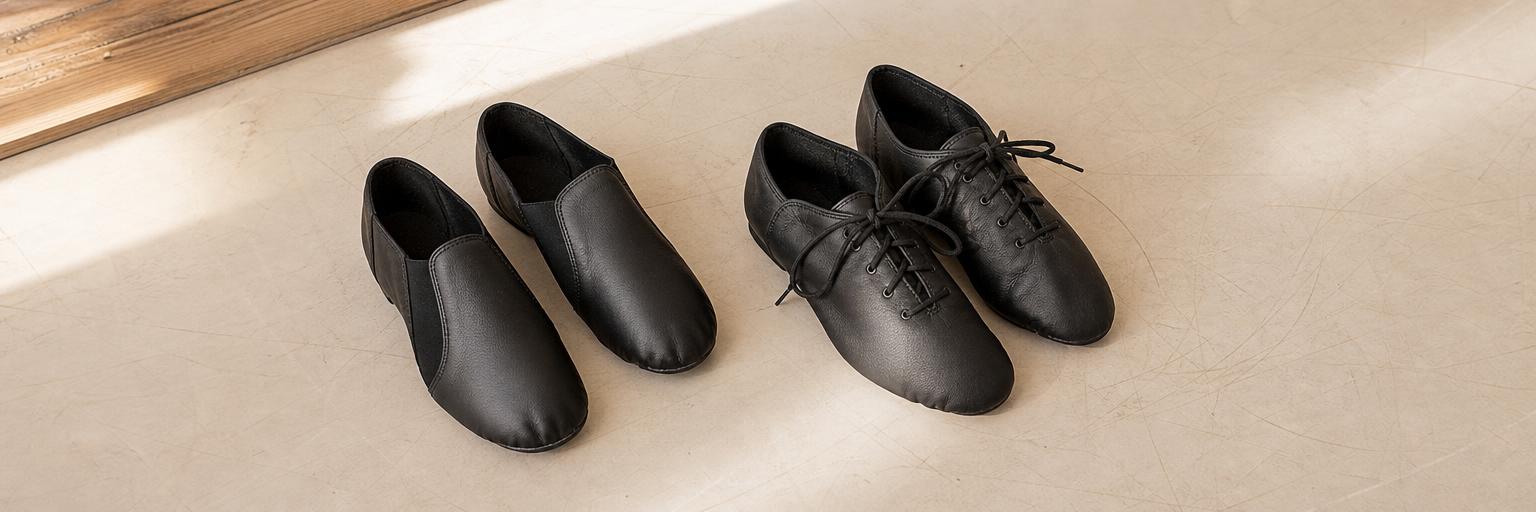
- Beginner, between sizes, or hate tight slip-ons? Bloch Jazzsoft or Dance Now DN980. Lace-up styles let you adjust. The trade-off: laces are less streamlined, so confirm your studio accepts lace-ups before buying.
- Wide feet? So Danca Janus / Jocelyn JZ45, XX-wide is published on the product page. Public sizing reports are still mixed, so order from a seller that lets you return on the first pair.
- Want canvas instead of leather? So Danca Jada / Jill / Vega JZ75 family. Stretch canvas is lighter and more breathable. Check whether your studio accepts canvas in class AND on stage. Some allow it for class only.
- Tempted by the cheapest jazz shoe on the shelf? That's usually Theatricals T7802 / T7702. They run small. They often appear in final-sale states. They're the budget pick only when you ALREADY know your size in that exact model. Otherwise the savings vanish.
- Considering Very Fine? Stop. Very Fine is a ballroom/social dance shoe, not a jazz shoe. Different sole, different intent. Ballroom And Social Dance Shoes if that's actually what you're after.
How to choose
- Read the studio's dress code or class rule FIRST. Tan split-sole slip-on means tan split-sole slip-on. A 20% discount on a black lace-up doesn't change that.
- Know why it's tan or black before you guess, because the color is doing a job. Tan is the competition and lyrical default. A skin-tone shoe blends into the leg and lengthens the line on stage, which is the whole point of the barefoot look under bright lights. Black is the class and rehearsal default, and a lot of musical-theater and traditional jazz numbers want it on stage too, because there the shoe is meant to read as a shoe rather than disappear. If the dress code names a color, that is the answer. If it doesn't, buy tan for a competition or lyrical solo and black for everyday class, and text the teacher before a stage number rather than guessing wrong twice. If your dancer needs a tan that actually matches deeper skin, read the deep-tone picks below, because the mainstream tan tops out at a light caramel.
- Pick split-sole for most class and competition use. Split-soles let the arch point cleaner. Full-sole shoes are more structured and can help beginners, but most studios past beginner level want split-sole.
- Sizing is where this goes wrong. Jazz shoes should fit snugly with toes flat near the end of the shoe. Curled toes, heel slip, or wrinkled fabric across the foot = wrong size. Don't talk yourself into a 'close enough' fit.
- Match the snugness to the material. Leather molds and gives a little as it breaks in, so a leather jazz shoe should feel snug, almost a touch tight, out of the box. Canvas barely stretches, so it will feel about the same in month three as it did on day one. Fit canvas to feel right now, not to break in. Sizing a canvas shoe roomy because you're expecting it to give is how a dancer ends up swimming in it all season.
- A leather or suede-soled jazz shoe lasts longer with the right care, and the wrong care kills it early. Brush a glazed suede sole back to grip in one direction, condition leather lightly so it does not crack at the flex point, and never machine-wash or heat-dry any of it. Dance Shoe Care, By Material has the routine by material so a worn-in pair earns a full season instead of half.
- Order your first pair from a seller with a real return policy. Try the shoe on carpet only. Don't mark the sole. Original packaging stays intact. That's the price of a clean return.
- Skip final-sale discounts when you've never worn that exact model. The shoe that's $8 cheaper today is $40 wasted if it doesn't fit.
- Lace-ups adjust, slip-ons look cleaner on stage. If the studio has said which one, that settles it. Ask if they haven't.
Sizing And Return Reality
Jazz shoe sizing is style-specific, not brand-specific. Don't assume your Bloch size in one style works in another. Our Cross-Brand Dance Shoe Fit Finder takes your everyday size and returns the jazz starting size per brand, so the per-page notes below confirm a number instead of replacing one.
- Bloch sizing varies by model. Some styles fit close to street size; others tell you to go up. Read the size note on the specific product page before ordering.
- Capezio's Freeform page tells women to start 1.5 sizes up, but specialty fitters size the same shoe at street to a half down for its stretch mesh, so the Freeform's size is genuinely disputed. Don't guess from the box on this one: order to Capezio's chart and buy where you can exchange.
- So Danca Janus offers XX-wide, but buyer reports STILL mention small fit. Order returnable.
- Theatricals T7802 runs small AND often appears in final-sale states. That combination is the most common 'wasted $25' in dance shopping.
- Bloch direct doesn't exchange. Anything 20%+ off is final sale. First-time buyers should buy from a third-party retailer with friendlier rules.
- So Danca returns require the shoe to look unworn, clean soles, original packaging, no visible try-on damage. Try on carpet only.
When The New Pair Feels Tight (Leather Molds, Canvas Won't)
This guide tells you to buy the leather pair snug and the canvas pair to feel right today, and that split matters the week the box actually shows up. A snug leather shoe is supposed to feel a little tight and will give as it warms to the foot. A tight canvas shoe is not breaking in, it is just tight, and it will be exactly that tight in March. Knowing which one you are holding tells you whether to wear it in or send it back.
- Leather is supposed to feel snug, even a touch tight, the day it arrives, and that is right rather than wrong. The upper softens and molds to the foot over the first week or two of class, so wear it in short stretches at home before the first real class instead of breaking it in on the studio floor. Don't size up to escape the snugness, because a leather jazz shoe that's roomy on day one is sloppy by month two.
- Canvas that feels tight is a return, and you start it today. Stretch canvas barely gives, so a tight canvas jazz shoe does not break in, it just stays tight and the toes pay for it all season. Don't try to wear it in. Begin the exchange while the sole is unmarked and the packaging is intact, which is the whole reason you bought from a returnable seller.
- Fit-test the way she'll actually dance. Jazz is usually danced barefoot inside the shoe or in a thin footie, not a crew sock, and that alone changes the fit by up to half a size. Try the new pair on the way she really wears it, or the carpet test tells you the wrong thing.
- Numb or tingling toes in the first few minutes means too small, full stop. The shoe should feel snug, not asleep. Heel slip and curled toes are the usual wrong-size tells the size chart warns about, but a foot that goes numb is the one symptom you never wear in, no matter what number is on the box.
- Retire a slip-on once the instep elastic goes slack. A jazz slip-on lives or dies by that gusset, and when it no longer hugs the instep the shoe slides on releve and looks loose through turns. A stretched-out elastic is the end of the pair, even when the leather still looks fine.
Make The Pair Last The Season
Jazz shoes get worn barefoot or in a thin footie, so they soak up more sweat than anything else in the dance bag and they show it fast. A leather pair that never dries out starts to smell and the seams give way months before the sole wears down. A little care here is the difference between one season and half of one.
- Air them out after every class and never seal a damp pair in a zipped dance bag. Sweat trapped against leather is what turns a shoe sour and rots the stitching from the inside. Pull them out of the bag when she gets home, loosen the elastic or laces, and let them dry in open air, not in a hot car or on a radiator, which dries the leather out and cracks it.
- Don't put leather jazz shoes in the washer or dryer. The heat and the tumble warp the sole and split the upper, and a leather shoe that has been through a dryer is done. Canvas slip-ons can take a gentle cold hand-wash when they get rank, but they air-dry only, never the dryer, because dryer heat shrinks canvas a half size and curls the sole.
- Rotate two pairs if she dances most days of the week. A jazz shoe needs a full day to dry all the way through, and a pair worn damp every single day breaks down at the seams and holds odor for good. For a dancer in the studio four or five times a week, a second pair on the off-days isn't a luxury. It's what gets a full season out of each one.
Also considered
- Bloch Super Jazz / Neo-Flex: the studio default that most dress codes assume you'll buy. Bloch's leather jazz lineage covers split-sole, full-sole, lace-up, and slip-on. Confirm the specific model your studio accepts before ordering.
- Bloch Pulse / Spark: the upgrade pair for clean foot line on competition stage. Stretch construction. Treat as an upgrade after your dancer has settled into a fit, not the first pair.
- Bloch Jazzsoft / Dance Now DN980: the lace-up option. Better for adjustable fit, but check whether your studio accepts lace-ups for competition. Some don't.
- Capezio E-Series / Freeform: Bloch's main competition. Widely available, but read Capezio's size note on each style. The Freeform is the tricky one: Capezio's page says women start 1.5 sizes up, but specialty fitters size it at street to a half down for the stretch mesh, so order to the chart and keep your exchange option.
- So Danca Janus / Jada: the wide-foot answer (Janus) and the canvas/lightweight answer (Jada). Strong second-tier picks when Bloch and Capezio don't fit right.
- Sansha Swing-Split / SOHO: budget lace-up option. US fulfillment and return policy are a question mark. Read both before committing.
- Theatricals T7802 / T7702: cheapest shoe on the shelf. Runs small. Often final-sale. Don't make it a first-time-fit purchase. Buy these only when you already know your size in that exact model.
Deep-Tone And Skin-Tone Jazz Shoes
Most jazz shoes sold as a skin tone stop at caramel or mocha, which is a light-to-medium tan that reads like a sock against deep-brown skin. If you need a genuinely dark shoe, the brand matters more than any dye, because leather uppers do not take dye evenly. Here is the honest split.
- The mainstream ceiling is caramel or mocha. So Danca Java JZ43 comes in Black, Caramel, and Mocha, and Capezio's EOS, E-Series, and Pedini Femme top out at Caramel. These work for light-to-medium tones and for the tan-equals-long-leg-line look in lyrical, but the darkest option is still a light tan, not a deep brown.
- For a truly deep tone, Blendz Apparel is the one brand that actually makes it. Its jazz shoes run in four True Tone shades, from Tenacious Tan through Brazen Brown and Maven Mahogany to a deep Confident Cocoa. Three lines, all brand-direct, with prices confirmed at Blendz in May 2026: the split-sole leather Icon around $48, the split-sole Legacy at $44 in black or $49 in Brazen Brown, and the slip-on Essence bootie at $64.
- Do not try to dye a mainstream caramel shoe darker. Leather takes dye blotchy and uneven, so the result usually looks worse than the mismatch you started with. The real fix for a deep tone is a shoe built in that shade, which on the jazz side means Blendz.
- Blendz ships from its own site only, so build shipping time into a costume deadline rather than expecting a studio or a local shop to stock it. We have no affiliate relationship with any brand named here. These are research picks, not paid placements.
- For the full deep-tone picture across ballet, pointe, half-soles, and where tap and character shoes still fall short, see where to find skin-tone dance shoes.
Skip it if
- Don't buy the cheapest sale shoe when your dancer hasn't worn that exact model and size before. The savings disappear instantly if the size is wrong.
- Don't assume jazz-shoe sizes match street shoes. The Bloch Jazzsoft sizes up about half a size for women per Bloch's own guide. The Capezio Freeform is messier: Capezio's page says add 1.5 sizes, but specialty fitters size it at street to a half down for its stretch mesh, so order to the chart. So Danca Janus runs differently again. Read each product page.
- Don't buy from sketchy marketplace listings. Authenticity, size accuracy, and return path all matter. The risk isn't worth $5 saved.
- Don't try to use ballroom or Latin practice shoes as jazz shoes. Different sole, different intent. They look close on a website and behave nothing alike on a studio floor.