Quick answer
Is a foot stretcher safe for my dancer, or should I buy a Theraband instead
When she is desperate for a better arch, the stretcher ads are all over her feed, and you are about to spend fifty dollars on a device that forces her foot into a deep point with no idea whether it helps or harms.
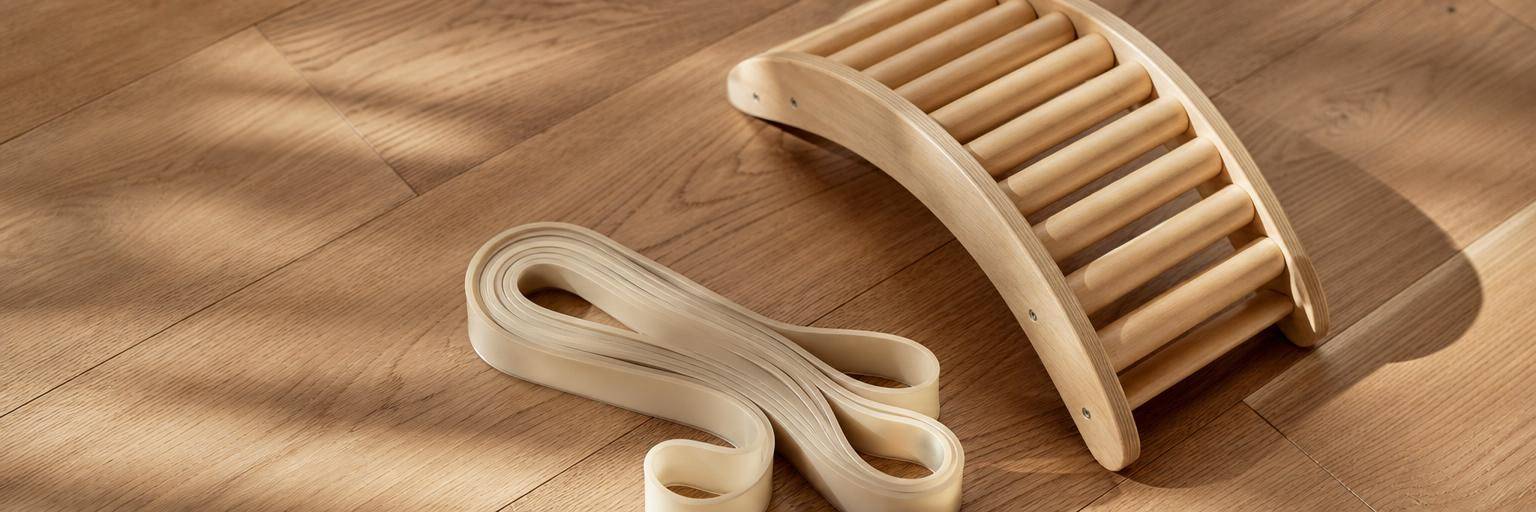
Quick read
Skip the foot stretcher as a way to fast-track her arch, and put the money toward a Theraband instead, because for a pre-pointe dancer the thing between her and pointe is almost always strength, not range. Most young dancers already have more flexibility in the foot than they can actually control, and a foot stretcher only adds passive range she has no strength to hold. That is the real risk: forcing the foot into a deep point compresses the structures at the back of the ankle and can cause posterior impingement, a real and painful injury, while over-stretching the ligaments dulls her sense of where her foot is in space, which is exactly the control pointe work demands. A Theraband, a few dollars, does the opposite job: it builds the intrinsic foot and ankle strength that actually supports an arch and steadies a landing, and as that strength comes in the usable arch usually improves on its own. The rule that keeps her safe is that any flexibility work belongs to her teacher or a dance physical therapist who can prescribe it and watch her form. A forcing device used alone at home, chasing a look off a screen, is how a pre-pointe foot gets hurt before it ever earns a shoe.
Gear for this situation
What to do
- Start with the Theraband, because it fixes the real problem. Pre-pointe readiness is about strength and control, not how floppy the arch looks, and a resistance band (a few dollars) is the standard tool for building the intrinsic foot and ankle muscles that hold an arch and steady a landing. Buy the band, not the stretcher, as the first and often the only purchase.
- Understand what a foot stretcher actually does before you spend on one. It passively forces the foot into a deep pointed position to add range. The catch is that most young dancers already have more range than they can control, so piling on more without the strength to hold it does not speed up pointe and can set up injury. More arch on a weak foot is not progress.
- Know the specific risk, because this is not vague caution. Over-pointing into a stretcher compresses the structures at the back of the ankle and can cause posterior impingement, a painful and real injury, and sustained ligament stretching dulls proprioception, her sense of where her foot is, which is the exact control pointe requires. That is why teachers and dance physical therapists are wary of these devices.
- Make any flexibility work teacher-directed, not a video-and-a-gadget project at home. If a foot stretcher has any place at all, it is gentle, brief, and prescribed by her teacher or a dance PT who watches her form and pairs it with strengthening. Ask her teacher what she actually needs before buying a single tool, the same teacher-first rule that applies to every conditioning purchase. The recovery and conditioning review covers the bands and rollers that earn their place.
- If you still buy a stretcher, treat it as a strength accessory, never a shortcut. Use it only under the teacher's instruction, only gently, and never to push past where she can actively point on her own. The job is to support the strengthening work, not to crank an arch into a foot that cannot yet hold it.
Common mistakes
- Don't buy a foot stretcher to catch her up to the dancers with prettier feet. Arch shape is mostly the bone structure she was born with, and forcing range she cannot control does not close that gap, it just adds injury risk. Strength is the part you can actually build.
- Don't let her crank a stretcher alone at home for a deeper point. That unsupervised forcing, chasing a look off her feed, is exactly the pattern that compresses the ankle and dulls her foot control. Any use is teacher-directed and gentle, or it does not happen.
- Don't skip the strengthening because the stretcher feels like progress. A deeper passive point with no strength behind it is the opposite of pointe-ready, so the band work comes first, every time.