Quick answer
What size recovery slide should I buy
When you have the OOFOS OOahh in size 8 and the Chacott in 24 cm open in two Amazon tabs, she is between a women's 7 and 7.5, and you do not want to gamble $60 on a guess that ends in a return.
Quick read
There is no single rule, because the four slides dancers actually buy size four different ways, and that mismatch is the number one reason recovery slides get returned. OOFOS comes in whole sizes only and is sized separately for men and women, and the brand says to size up to the next whole size if you are a women's half size, so a 7.5 buys the 8. Gliss also runs whole-sizes-only on women's US sizing, but its last is built wide for high arches, so the brand tells narrow or shallow feet to size down while a wider in-between foot takes the nearest whole size. Chacott is the real trap, sized by foot length in centimeters rather than US size, so you measure your foot and order off the chart, sizing up when you land between bands. HOKA runs US sizing but its Ora slide is unisex and always labeled in men's sizes, so a woman subtracts two from her usual number (a women's 10 is a men's 8) and aims for a secure-but-relaxed fit, not snug. Across all four a recovery slide should sit relaxed but stay on the foot on its own, never gripped with the toes. Our recovery footwear review carries the full per-brand chart.
Gear for this situation
What to do
- Find out which sizing system your slide uses before you look at a single size, because the four slides dancers buy most do not agree. OOFOS, Gliss, and HOKA all run in whole US sizes only with no half sizes, while Chacott runs centimeter foot-length sizing. Then watch for listings labeled in men's sizes (HOKA always, OOFOS on its men's run), where a women's-size shopper drops two before ordering.
- If you are a women's half size in OOFOS, size up to the next whole size. The OOahh comes in whole sizes only, sized separately for men and women, and the brand's own rule is that a half size rounds up, not down, so a 7.5 takes the 8 and the slide sits relaxed instead of pinching.
- If you land on a men's-labeled OOFOS listing, subtract two from your women's size. OOFOS sells the same slide in separate men's and women's runs, and its own size labels line up a women's size with the men's size two below it (a women's 8 and a men's 6 are the same shoe), so a women's-size shopper on a men's listing picks two sizes down, or just buys from the women's listing to skip the math. One more thing to watch on those off-brand listings: real OOFOS hold minimum advertised pricing right around $59.95 everywhere, so a $35 listing from an unfamiliar seller is almost certainly a counterfeit, the kind that packs flat in weeks. The full price-as-authenticity-check, OOahh versus OOahh PLUS pick, and machine-wash care live in the OOFOS for dancers answer.
- For Gliss, let the arch decide. Gliss builds its slide on a wide, high-arch women's last and runs whole sizes only, so the brand tells narrow or shallow feet to size down a whole size while a wider or in-between foot takes the nearest whole size. A high-arched dancer is usually the foot this slide was made for.
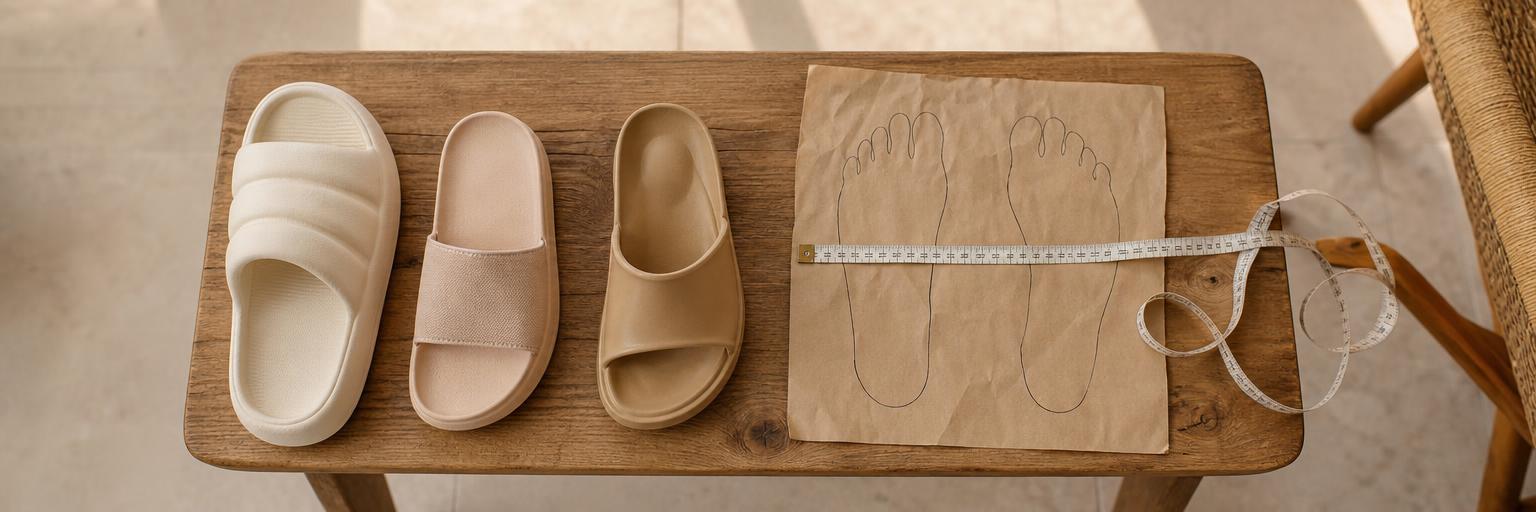
- For Chacott, measure your foot in centimeters and order off the chart, never off your US size. Stand on a sheet of paper, mark your heel and longest toe, measure the gap, and match the band (XS 22.5 to 23.5 cm, S 24 to 25, M 25.5 to 26.5, L 27 to 28). When you land between two bands, size up, because centimeter-to-US guessing is the single most common return on this shoe.
- For HOKA, expect the same trap as OOFOS, because the Ora Recovery Slide 3 is unisex but labeled in men's sizes. It comes in whole sizes only (3 to 14, no half sizes), and HOKA's own rule is that a woman subtracts two from her usual women's size, so a women's 10 orders a men's 8. With no half sizes to split the difference, a between-sizes foot rounds up, since a recovery slide should sit relaxed, not snug. Buy it in person at REI or Fleet Feet if you can, so the men's-label math does not bite you at the door.
- Size for the foot at the end of the day, not first thing in the morning, because that is exactly when a recovery slide gets worn. Feet swell across a full day of class, rehearsal, or a competition, so a slide that felt perfect in the morning can feel tight by the time she actually reaches for it after the last number. If you can only try one time of day, try late. And here is the one place the usual dance-shoe rule flips. With a technique shoe you fit the foot today and never size up for growth, but a recovery slide is worn relaxed and never has to grip for a turn, so for a still-growing dancer a little length to grow into is fine and even smart. The only hard limit is that it still has to stay on her foot without toe-gripping when she walks.
- Before you size any of these for a young dancer, check that her foot has actually grown into the smallest adult size, because every brand here is an adult or unisex recovery line and none is made in a true children's size run. The smallest size on offer lands around a youth 4 or women's 5, which is right where Chacott's own XS band starts at 22.5 cm. So measure her foot in centimeters first, and if it comes in under about 22 cm, a recovery slide in these brands is either not made that small or will slide off her heel no matter how you size it. For a foot that small, a soft everyday slide or her own sandal does the same post-class cooldown job until she grows into the adult range, and you have not spent $40 or $50 on a slide she swims in.
- Because a wrong guess is the likely first outcome on these, order in a way that protects the return. A foam recovery slide loses its returnable condition the moment it goes outside, since the footbed picks up grit and the soft sole scuffs on the very first walk to the car, and most sellers will not take back a pair that has been worn outdoors or shows wear on the foam. Try the fit indoors on a clean floor only, walk the house in them, and keep the box and the tags until you are sure of the size. Check the fit against the brand's rule the day the box arrives, not the week of the recital, so a wrong guess still has room to exchange inside the return window. Buying from a seller with a return path only helps if that first wear does not void it.
- Whatever the brand, aim for a slide that sits relaxed but stays on the foot on its own. If your dancer has to curl her toes to keep it on, it is too big and a trip risk on backstage stairs. Buy OOFOS and HOKA where you can try a size on (REI, Fleet Feet) and Gliss or Chacott from a dance boutique with a return path. The full per-brand breakdown is in our recovery footwear review, and the adjacent home-recovery gear (foam roller, massage ball, hot/cold pack, stretch band) lives in the recovery and conditioning tools guide for the parent assembling a real after-class kit instead of just a slide.
Common mistakes
- Don't order Chacott in your US size. Centimeter sizing does not line up cleanly with US, and a half-size guess is exactly how these get returned. Measure your foot and read the chart.
- Don't size a women's half size down in OOFOS. The brand rule is to round up to the next whole size, so going down leaves the slide tight and kills the decompression you bought it for.
- Don't assume Gliss runs like a mainstream slide. The last is built wide for high arches, so a narrow foot that buys true-to-size will swim in it, and narrow or shallow feet should size down a whole size.
- Don't buy a recovery slide tight to feel secure. A snug recovery slide defeats the purpose, since the foot needs room to decompress. Secure-but-relaxed is the target, and a slide that stays on without toe-gripping is correctly sized.
- Don't order HOKA in your usual women's number off a men's-labeled listing. The Ora Recovery Slide 3 is unisex but shown in men's sizes, so a woman subtracts two (a women's 10 is a men's 8). Order your normal number and you get a slide two whole sizes too big that slides off on backstage stairs.