Quick answer
What majorette boots do I buy, and what size for a dance team
When the team needs matching boots for the season, the brands all look alike, the sizing runs small in a way regular shoes do not, and you are about to order for one dancer or fifteen with no idea how much to size up.
Quick read
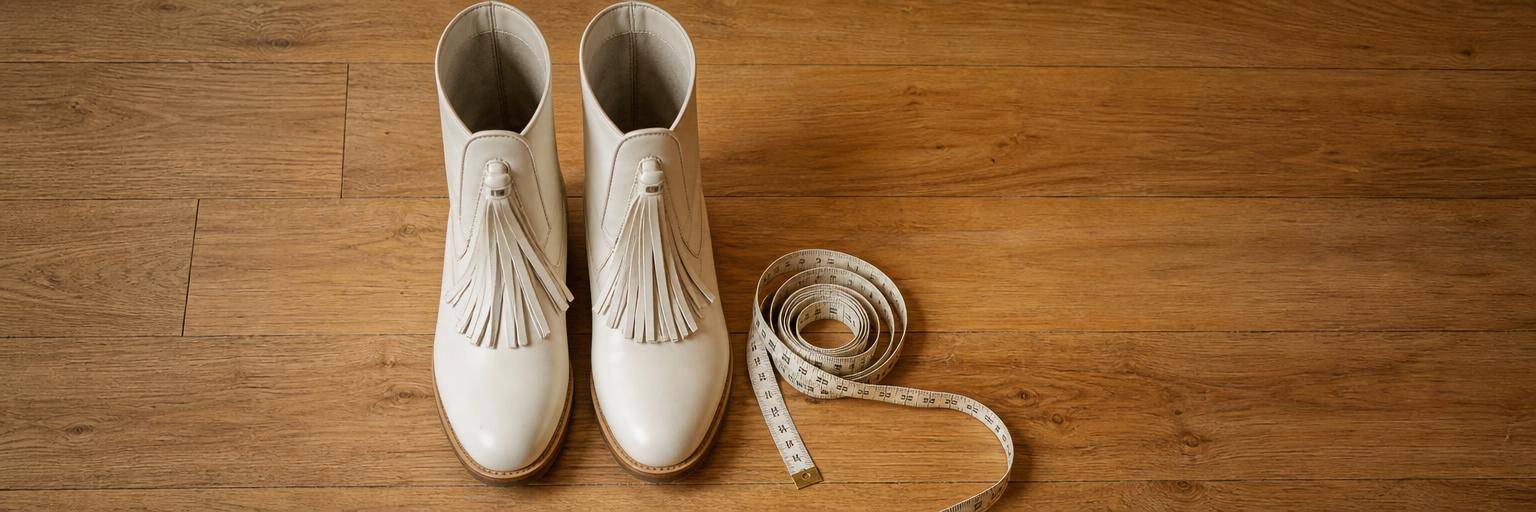
Majorette and dance-team boots are their own category, the knee-high boots in white or black with the tassels, and the three names you will see are Gotham, Dinkles, and StylePLUS, all carried together at Band Shoppe along with Superior Cheer and Ponseti's. They are more alike than different, so the brand matters less than the one thing that trips up every first order: the sizing. Majorette boots run small, noticeably smaller than street shoes, so you size up, about a half to a full size for an adult and a full size for a youth dancer, and you order off the brand's own chart rather than her sneaker number. Order from the youth range for a kid and the adult range for a teen or grown dancer, because the two are cut differently and do not cross over. The tassels are usually removable, which is handy when the team wants a different look for a parade versus a performance or wants to match a color. If you are the one ordering for a whole team, the size-up problem is the whole game, because one wrong assumption multiplied across fifteen dancers is fifteen returns, so order a single sample pair or run a quick try-on in the size you think before you place the bulk order, and buy from a retailer like Band Shoppe that handles team orders and keeps the line in stock so a mid-season replacement still matches.
Gear for this situation
What to do
- Size up, because the one rule that matters is that majorette boots run small. Plan to order about a half to a full size larger than her street shoe for an adult, and a full size larger for a youth dancer, off the brand's own size chart rather than her sneaker number. A too-small boot is the number-one first-order mistake and the reason for most returns.
- Pick the brand last, because they are more alike than the listings make them look. Gotham, the most common, plus Dinkles and StylePLUS all make the knee-high majorette boot, and Band Shoppe carries all three together with youth and adult sizes, alongside Superior Cheer and Ponseti's. Choose by what is in stock in the right size and the team's color, not by brand loyalty.
- Order from the right age range, youth or adult, and do not cross them. Youth and adult majorette boots are cut differently, so a kid goes in the youth range and a teen or grown dancer in the adult range; ordering an adult size for a child to save a step gives you a boot that fits wrong even after the size-up.
- Use the removable tassels as the flexible part. Most majorette boots come with tassels that snap or tie off, so the team can run them for a parade and pull them for a cleaner performance look, or swap to a color that matches the uniform. It is the one part of the boot you can change without rebuying.
- Sample before you bulk-buy if you are ordering for the team. The size-up problem multiplied across a roster is a pile of returns, so order one or two sample pairs or run a quick try-on in the size you think before placing the group order, and buy from a retailer that handles team orders and keeps the line in stock so a mid-season replacement still matches. The studio team uniform reorder playbook covers the group-order and replacement logistics.
Common mistakes
- Don't order her street size. Majorette boots run small enough that her usual number lands too tight, and a boot you cannot comfortably wear through a parade or a routine is a wasted order. Size up off the brand's chart, every time.
- Don't mix youth and adult sizing on one team to save effort. The two ranges are cut differently, so an adult size on a younger dancer fits wrong even at the right number, and the line will not look uniform. Order each dancer from her correct range.
- Don't place the whole team's bulk order on a guess. One wrong size-up assumption across fifteen dancers is fifteen returns and a delay you do not have before the first performance, so confirm the fit with a sample pair or a try-on first.