Quick answer
What is the difference between a recital and a competition
When the studio's new-family orientation just used the words recital and competition in the same paragraph, your costume invoice has two line items you cannot tell apart, and you want to know whether to budget once or twice this year.
Quick read
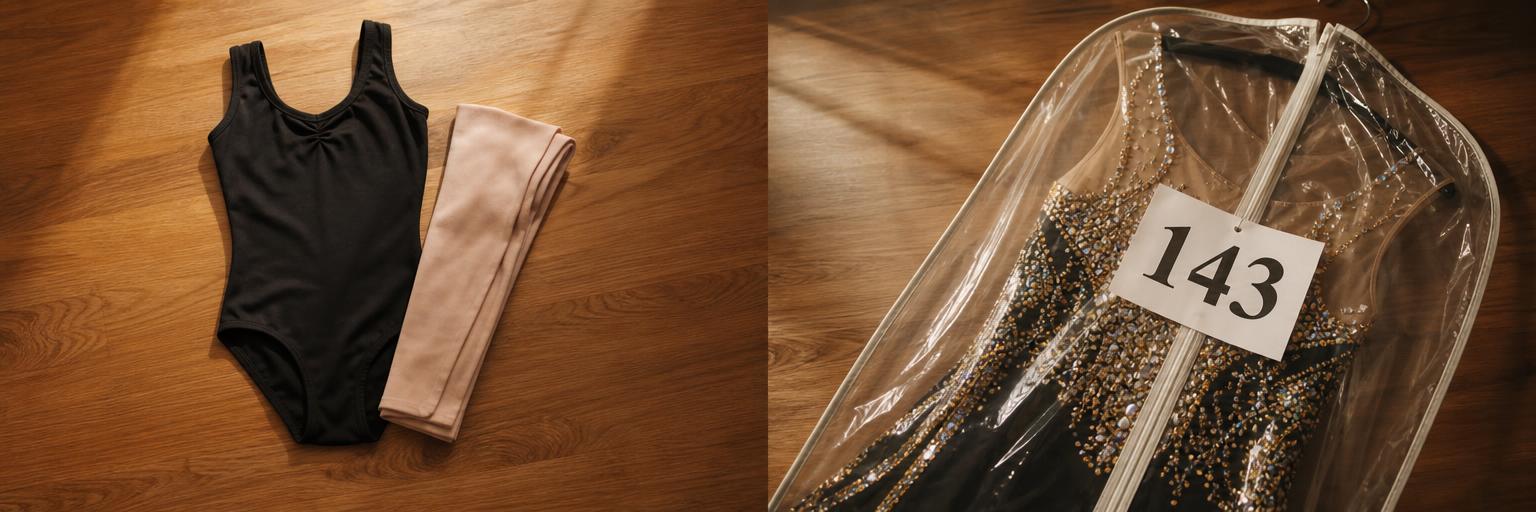
A recital is the all-studio year-end performance where every enrolled student performs once. A competition is an optional judged event for select teams. The gear difference is real: recital means one costume (usually studio-specified), required shoes and tights, and basic hair and makeup. Competition multiplies that by the number of routines in the season, adds a competition bag, garment bags per costume, a stage makeup kit, and backup tights in every required color.
Gear for this situation
What to do
- Know which event you're actually preparing for right now. If your child is in a regular weekly class, they're in the recital track, not competition. If your child was invited onto or tried out for a competition team, they're in both. These two events have completely different timelines, gear lists, and costs. You don't need to understand both at once if your child is only in one.
- Recital: the studio sends a costume sheet 2-4 months before the show. That document tells you the required shoes (style, color, heel height), tights shade, hair requirement, and any makeup notes. Until the costume sheet arrives, do not buy anything recital-specific. The sheet is the shopping list.
- Competition: the studio sends a new-member packet in August or September when the season starts. That packet lists every required gear item, the competition schedule, and cost estimates. Until the packet arrives, do not buy competition gear. The packet is the shopping list. See the full first-season breakdown at My child was just invited to join the competition team. What do I need to buy?.
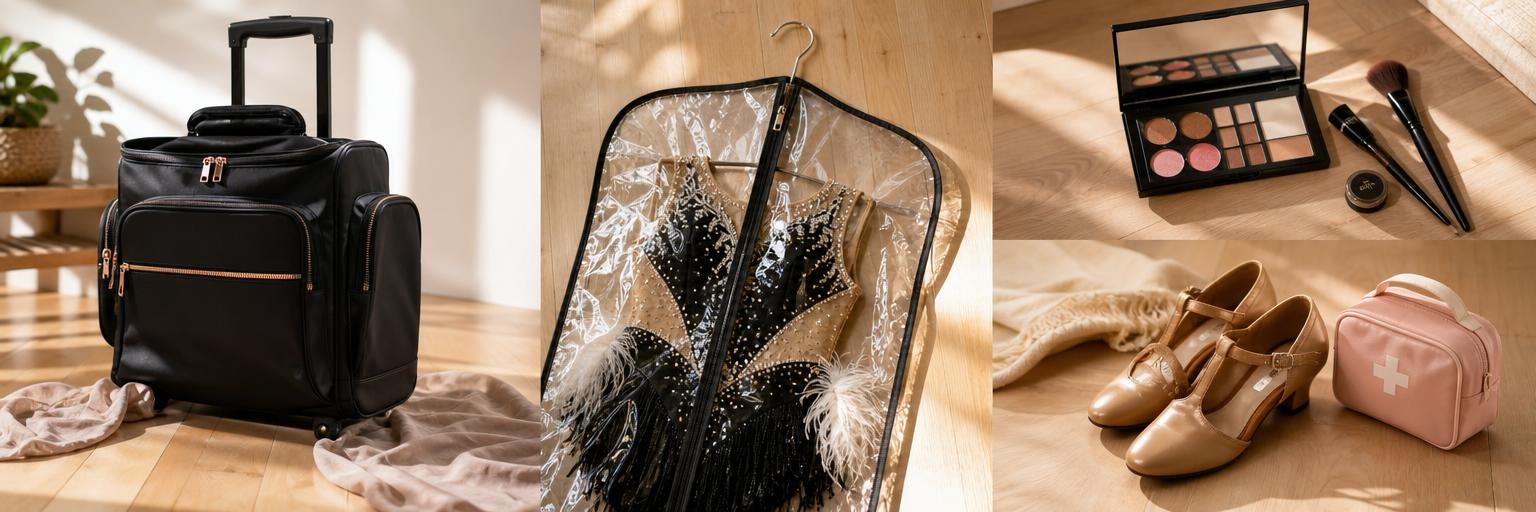
- The main difference in what you carry to the event: a recital family brings one or two costumes in a garment bag, the required shoes, and the hair and makeup the costume sheet specifies. A competition family brings a rolling rack bag with a separate labeled garment bag for each routine, shoes per routine, a full stage makeup kit, backup tights in every required color, food for a long event day, and a pop-up changing tent when the venue has open backstage, since the surprise most first-year competition families hit is that the dressing area is one big curtained room and there is no other private place for a six-year-old to change between numbers. The rolling-rack-and-multi-garment-bag setup assumes an older multi-routine dancer; if your dancer is 5 to 7 on a mini team with one routine, the gear list is dramatically shorter and the mini-specific first season walkthrough replaces the maximalist version.
- The main difference in gear cost: a first recital typically adds $50-200 in gear (shoes, tights, hair supplies, makeup basics). A first competition season commonly runs $300-600 in gear across the bag, makeup, shoes for multiple routines, and garment bags, on top of competition entry fees and travel if events are out of town.
- Budget for the event day itself, not just the gear, because the day is where the two diverge most and first families get caught off guard. A recital is one show. You buy theater tickets (often $15-25 each) and watch your child perform once, usually in a single afternoon or evening. A competition is an all-day event at a convention center or theater where the venue charges a spectator admission per person per day (commonly $20-35), so every relative who comes to watch pays it, and your child's two or three minutes happen in a scheduled slot buried inside a long day. Plan for a lot of waiting between routines, pack food, and budget admission for everyone coming to cheer, not one or two tickets.
- The difference that matters most before you say yes is the commitment, not the gear. A recital is simply where the weekly class your child already takes ends up, one show at the end of the year, no extra nights. Competition is a season. Most teams add rehearsal hours in the fall (often a second weeknight or a Saturday block on top of regular class), then compete on weekends from roughly January through April or May, with several of those weekends given over to all-day events and sometimes an overnight stay. Many studios ask you to sign a commitment for the full year, because a competition routine is choreographed around a fixed number of dancers, and one child dropping in March leaves a hole in a formation the whole group has drilled for months. None of that is a reason to steer away from competition, since plenty of families love the season and the team becomes their people, but go in knowing you are committing your spring weekends and an extra rehearsal night or two, not only a bigger gear budget. If your child mainly wants to dance and perform without the calendar taking over the household, the recital track does exactly that.
- Understand how a competition is actually scored before you walk into one, because the awards format surprises first families and can confuse a young child. Most competitions use an adjudication system where every routine earns a tier (the names vary by company, but think Gold, High Gold, and Platinum), so nobody comes home with nothing and a dozen routines can all land the same level. Layered on top of those tiers are overall placements (first through tenth within an age and level division) and special judges' awards. The part that trips up new parents is that Gold often sounds like the top prize when it is really the entry tier, with High Gold and Platinum above it. Walk your dancer through the tiers ahead of time so a Gold reads as the accomplishment it is and not a letdown. A recital has none of this: no score, no placement, no comparison to another studio, just your child performing the dance they learned. If your family does better with effort celebrated than effort ranked, that difference is worth weighing as heavily as the cost and the calendar.
- If you're not sure yet which track your child is on: buy only what the current class requires. The recital costume sheet or competition packet arrives on the studio's schedule and tells you exactly what to get. Don't build a competition kit until you know you need one.
Common mistakes
- Don't buy competition gear before the studio sends the required-items list. Competition teams specify exact makeup colors, tights shades, and sometimes bag type. Buying before the spec arrives almost always means buying wrong and buying again.
- Don't decide between recital and competition at the team interest meeting. The August enthusiasm wears off by November when the actual rehearsal calendar shows up, and many first-year families say yes in the room because everyone else is. Let yourself sleep on it for a week before signing. The studio will hold the spot 7 days; if it won't, that itself is the answer.
- Don't assume all competition events are equal. A one-day regional event and a four-day national competition have completely different gear and logistics requirements. The studio schedule in the packet tells you which events are on the calendar and what each involves.
- Don't overbuy for a first recital. The costume sheet tells you everything required. If it's not on the sheet, it's probably not needed. First-year recital families commonly overspend on hair accessories, extra tights, or makeup kits that the studio didn't ask for.