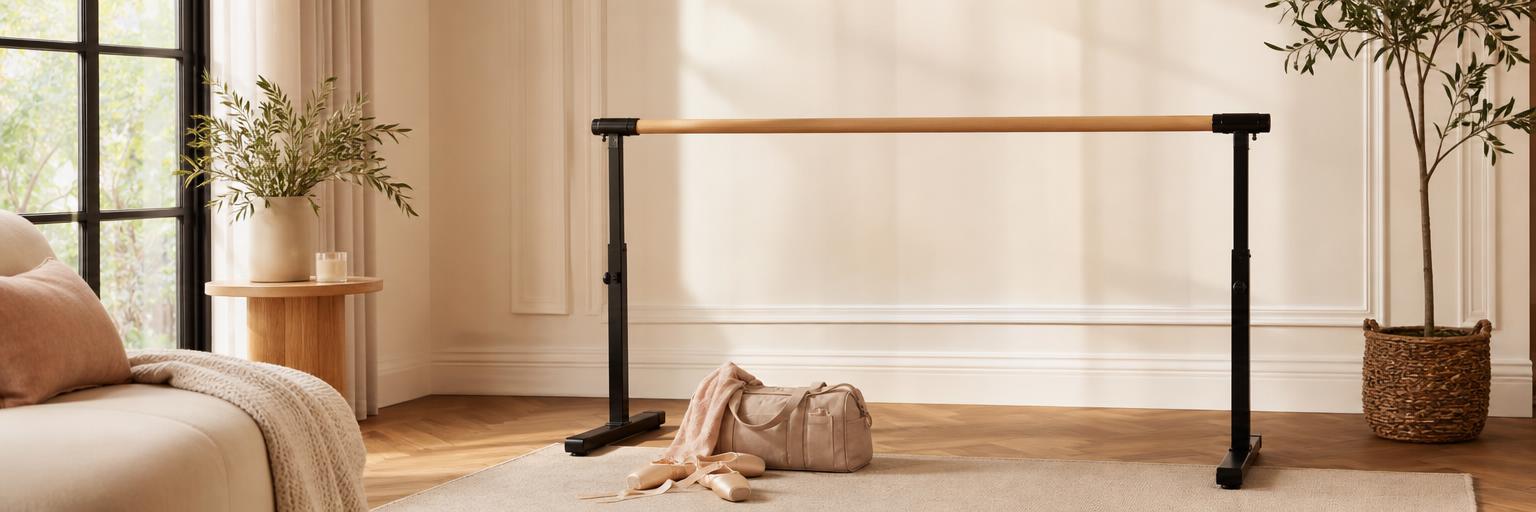
A chair back or kitchen counter gets you through the first year. Once your dancer is doing real barre exercises daily, or the teacher is assigning home barre work, a dedicated barre is worth buying. The right one for most families is a lightweight adjustable double-bar freestanding barre in the $120-150 range. The studio-grade versions ($340+) are for actual dance studios. Wall-mounted beats freestanding for stability, but you have to commit to drilling into a wall. The real decision here is timing, not which model. Buy once the daily habit is real, not to create it.
First barre, occasional home practice: Vita Barre Prodigy Aluminum. Lightweight, easy to move, height-adjustable, double bar. Adequate for everything except full-weight adult professional pointe work.
Daily serious practice, teen or adult dancer: Vita Barre Prodigy Ash or Maple Wood. Same frame as the aluminum, wood bar gives a slightly more stable grip feel. Maple is currently on sale and worth checking first.
Permanent home studio: wall-mounted. More stable than any freestanding option, no floor footprint. Wall installation goes into studs, so if you are renting, ask the landlord first.
Don't buy: Vita Barre Professional or Extreme Series ($340 to $400). These are heavier-gauge steel built for commercial studios putting dozens of dancers through a barre every day, and that weight works against you at home where you want the barre to slide out of the way after class.
Under $80: most barres in that range cut the foot width and the height range short of the Prodigy line, so the dancer outgrows the lower setting before the barre is paid off. The extra $30 buys a barre that stays stable as she leans into it and adjusts up as she grows.
Before you buy
Measure the room before you order. Most freestanding barres have a base footprint of 30 to 40-plus inches wide, and the dancer needs clearance on both sides to extend a leg without hitting a wall, so check the space at full reach, not just whether the barre fits in the corner.
Check the height range on the specific model against your dancer's current height, since most Prodigy models adjust from roughly 32 to 44 inches. A young child uses the lower range, a teen or adult uses the upper range, and the product page lists the exact numbers.
Buy double bar over single bar when the budget allows. The price gap is small and you get two heights, the lower bar for younger dancers and the upper bar as they grow, and both come in handy for different exercises.
Buying it as a gift? Confirm the dancer actually does home barre exercises first, because plenty of dancers do every plié at the studio and never need a barre at home, and a $120 surprise gift that lives in the basement is no fun to wrap.
How to approach it
The home barre question is first a use question, not a product question. A chair back genuinely works for the first year of home practice, especially for a young dancer who may not commit to daily home barre work. The Vita Barre Prodigy Series is the right barre when the dancer is doing consistent teacher-assigned home exercises or self-directed daily practice at 3+ times a week: enough that stability and the right bar height actually matter. Beyond the Prodigy Series, the only other decision point is permanent studio space: if you're drilling into studs, wall-mounted is categorically more stable than any freestanding option.
What we would do
For a dancer who has just started home barre exercises: wait to see whether the practice habit sticks for 4-6 weeks before buying a barre. A chair or countertop works for the short-term test. For a dancer doing consistent daily or near-daily home barre work: Vita Barre Prodigy Aluminum at $119.95 from vitabarre.com directly. Lightweight, double bar, adjustable height, no tools required. Only upgrade to the wood bar version if the dancer prefers the feel and does enough home practice to justify it. Avoid the Professional and Extreme Series ($340-400): heavier gauge steel designed for commercial studio daily use, which is a disadvantage at home where the barre needs to be moved.
How to work out which one
Before buying, answer one question honestly: is your dancer doing home barre exercises right now, or are you planning to buy the barre to encourage the habit? If she's already practicing consistently, the barre pays off immediately and the Vita Barre Prodigy Aluminum is the right call. If you're hoping a barre will create the habit, spend 4-6 weeks on a chair back first. If the habit sticks, buy the barre. If it doesn't, you haven't spent $120. When you're ready to buy: measure the room (freestanding barres need 30-40 inches of base footprint plus clearance on both sides), check the height range against the dancer's current height, and decide double bar over single bar unless you have a specific reason not to. The Prodigy Aluminum covers almost every home-practice situation at $119.95.
Mistakes to avoid
Don't buy the Professional or Extreme Series barres for home use. They're heavier, more expensive, and designed for commercial studio traffic: dozens of students per day. The extra weight is a disadvantage at home where the barre needs to move. Don't buy single bar when double bar is available for a small price difference: two heights are worth it. Don't buy a barre as a gift without knowing the dancer has a specific home-practice habit. A $120 object that sits in the corner is not a good gift.
Most stable setup; no floor footprint. Correct for serious daily training in one location.
Wall type (studs required for safe installation). Renter vs. homeowner status. Committed location.
Freestanding Vs Wall-Mounted
The choice between freestanding and wall-mounted matters more than which freestanding model you pick. Here is the decision in plain terms.
Factor
Freestanding
Wall-Mounted
Stability
Some wobble is normal. A freestanding barre is for light balance and warm-up, not for hanging your full weight on, so it is not the support an adult needs for pointe work
Very stable, comparable to a studio barre when properly installed
Portability
Can move between rooms; stores in a corner
Fixed location; cannot be moved
Installation
None, assembles in minutes
Requires drilling into studs; not renter-friendly without permission
Cost
Prodigy Series $120-$150; adequate for home
Brackets less expensive; installation labor adds cost
Best for
Renters, multi-room households, anyone who moves
Dedicated home studio, homeowners, serious daily training
Setting It Up So It Actually Gets Used (And Stays Safe)
The hard part of a home barre isn't picking it, it's making sure it gets used and stays safe once it's standing in the room. A barre that sits unused is the expensive furniture this guide keeps warning about, and a freestanding one used wrong is a fall waiting to happen. Here is how to set it up so neither happens.
Put it where she already warms up, not in a spare room down the hall. The barre that gets used is the one she walks past every day, so a bedroom corner by a window beats a basement she has to make a trip to. The unused-furniture problem is as much about placement as it is about timing.
Set the bar at about her waist-to-hip height, then confirm it by feel rather than the tape alone. Standing tall with her hand resting on the bar, her elbow should be slightly bent and her shoulder relaxed down, with the hand a little in front of her body rather than straight out to the side. A bar set too high makes the shoulder hike up and throws off the very alignment the barre is meant to support; too low and she hunches and grips, which is the exact fault that makes a freestanding frame unsafe. On a double bar the lower bar usually suits a younger or shorter dancer and the upper a teen or adult, so dial in the one she will actually use. When you are not sure, the teacher can eyeball it in ten seconds, because she sets dozens of dancers at the studio barre every week.
Fingertips rest on the bar, she never grips it or pulls against it. This is the one rule that keeps a freestanding barre safe, because the frame is built for light balance and not for body weight. If she's hauling on the bar to hold a position, the bar is set too low or the exercise is past what a freestanding frame should be doing. Hands resting on top, never hanging off it.
Steady the feet and keep the frame tight. A thin grippy mat or a strip of rubber shelf liner under the feet stops the slide on hardwood and the wobble on carpet. Snug every bolt when you assemble it, then snug them again after the first week, because the joints settle in and a loose bolt is most of the wobble people end up complaining about.
Stand a mirror where she can see her own line. Practicing alone without a mirror builds habits she can't see and the teacher isn't there to catch, so a plain full-length mirror leaned and anchored against the wall (secured so it can't tip onto a child) turns solo barre from guesswork into real self-correction. It's the cheapest thing you can add that makes the barre worth more.
Let the teacher decide what she drills, you just set up the space. Don't build a home barre routine off a random video, because half of cleaning up technique is doing the right thing the right number of times. Ask the teacher what to practice at home and how often, and then the barre's whole job is to be there and steady when she does it.
The shortlist
First barre for a dancer doing occasional home practice: Vita Barre Prodigy Series Aluminum Double Bar (~$119.95). Adjustable height, double bar (two height options), lightweight enough to move between rooms. This is the right pick for 90% of home-practice buyers.
Dancer doing serious daily barre work (30+ min, teen or adult): Vita Barre Prodigy Series Ash Wood Double Bar (~$139.95). Same adjustable frame as the aluminum, wood bar surface for a more traditional feel. The Maple version (~$149.95, currently marked down from $181.95) is the same quality at a slightly better feel if in stock.
Permanent home studio space where you want real stability: wall-mounted brackets. More stable than any freestanding barre, cheaper long-term, and the correct setup if the dancer is doing consistent serious training in one room. Check Vita Barre wall-mounted options for bracket kits. Requires wall installation.
How to choose
Is this for occasional home practice or daily serious training? For occasional practice (once or twice a week, warm-up barre before class), the Prodigy Aluminum is enough. For daily serious training (30+ minutes, technique work, teacher-assigned exercises), the Ash or Maple Wood is a better long-term choice for the bar feel.
Freestanding or wall-mounted? Freestanding is movable and requires no installation. Wall-mounted is more stable and better for serious training, but requires drilling into a wall and committing to a location. If you rent or move frequently, freestanding is the only practical answer.
What height range does the dancer need? The Prodigy adjusts from 6 inches all the way up to 46 inches off the floor, so one barre covers a 6-year-old at roughly 32 inches through a teen or adult at 42 to 44, and the floor drops low enough for kneeling and stretching work too. A young child (age 6-9) typically sets it at 32-36 inches, an older teen or adult at 38-44. A double-bar barre gives two heights at once, which is worth the small premium over single-bar. Check the product page for any model that lists a different range.
Pick the bar length before you check out, because it is a required choice and the one that decides whether the barre fits both the room and the dancer. Vita Barre sells the Prodigy in 4, 5, 6, 7, and 8 foot lengths, running from about 11 pounds at 4 feet to 15 at 8. A 4 foot bar suits one dancer drilling in a bedroom corner; a 5 or 6 foot bar lets her travel a few steps along it or lets two dancers share, but it wants 5 to 6 feet of clear wall-free floor to live against. Measure the room against the bar length, not just the 28 inch foot width, because the long bar is the part that actually eats the wall.
Do you need a single bar or double bar? Always buy double bar if the budget allows it. The second bar is useful for two-dancer households, for the dancer as she grows, and for proper barre structure (lower bar for young children, upper bar for adults). The price difference between single and double is small on the Prodigy Series.
The Professional Series ($340-$350) and Extreme Series ($380-$400) at Vita Barre are designed for commercial studio daily use. They are heavier and more stable, but that weight is a disadvantage in a home where the barre needs to be moved. Buying studio-grade equipment for home practice is overkill for most families.
Tempted to build one instead of buying? Be honest about which kind. A wall-mounted DIY barre, a length of 1.5 to 2 inch hardwood rod or a sturdy closet pole on brackets screwed into the wall studs, is genuinely as good as a bought one and usually cheaper, and it is the same wall-mounted setup the shortlist already points serious daily dancers toward. A freestanding DIY barre is where home builds go wrong. PVC pipe flexes and bows the moment she leans in, which is exactly when a balance aid has to hold, and a homemade frame almost never gets the wide weighted base that keeps a real freestanding barre from tipping. So if you want freestanding, buy the frame. If you are handy and have a wall you can drill, the wall-mount build is the one worth your weekend.
Before buying: measure the space where the barre will live. The Prodigy's feet are about 28 inches wide to keep it from tipping, but the foot width is the small dimension to plan around. The bar length you picked above is the one that decides the footprint, so measure the wall run against that 4-to-8-foot bar, and leave enough clear space on both sides for the dancer to extend her leg without hitting furniture.
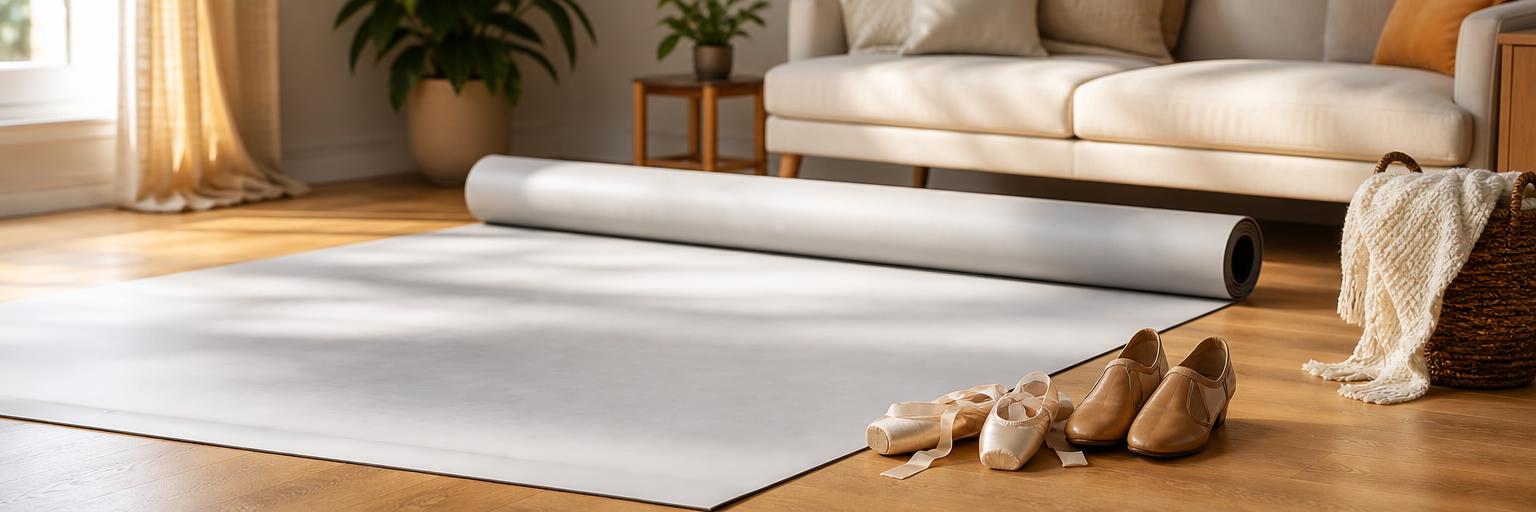
Think about the floor the barre stands on, not just the barre. A freestanding barre needs a hard, level surface to sit flat and stay put. On thick carpet the feet sink unevenly and the frame wobbles more; on bare hardwood the feet can slide when she leans in, so a thin grippy mat under the feet steadies it on either surface. The dancer also needs a real surface to work on, not a slick wood floor or deep carpet. If she is doing more than plies at this barre, read our dance floors and shoe care guide before setting up the space.
Skip it if
Don't buy a barre before the teacher starts assigning barre homework or the dancer is practicing at home on her own initiative. A barre that sits unused is an expensive furniture piece. A chair back works fine for occasional casual use.
Don't buy single-bar when double-bar costs only $20 more. A second height option is useful as the dancer grows and as technique advances. The double-bar Prodigy is the standard home-practice choice.
Don't buy the Professional or Extreme series for home use. They are heavier, harder to move, and designed for studio floors with professional-grade base weight. The extra stability they provide is not useful in a carpeted bedroom or small home studio.
Don't mount a wall barre without checking with your landlord if you rent. Wall-mounted barres require studs for proper installation, and improper installation on drywall without studs is a fall risk. This is a safety issue, not just a property issue.