Picks at a glance
Price$5.00, verified 2026-08-02
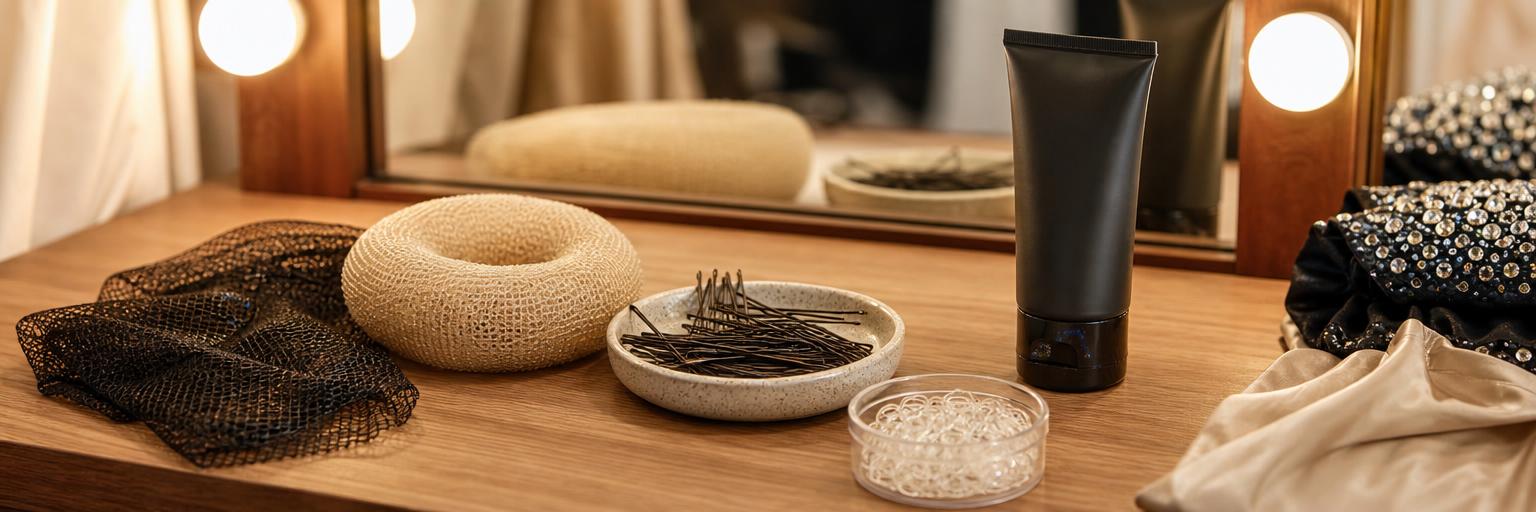
Why it wins$5 buys enough nets for a season, and a net is the difference between a bun that survives a leap pass and one that does not.
Where it falls shortShade matters more than people expect. A dark net on light hair reads as a smudge from the audience, and you cannot return it once the packet is open.
Check before buying4 of the 6 shades were in stock at check time. Hair products are non-returnable once opened, so buy the shade that matches her hair the first time.
Check at Bunheads →Price$11.00, verified 2026-08-02
Why it winsHolds a hairpiece through a full number without the headache that comes from pinning it tighter and tighter.
Where it falls short$11 for a consumable, and it does nothing for you if the underlying bun was built badly.
Check before buyingIn stock at check time. Single item, not a kit: it solves one problem well and nothing else.
Check at Bunheads →Price$2.99, verified 2026-08-02
Why it winsThree dollars, fits in a pocket, and solves the single most common backstage panic there is.
Where it falls shortIt is a handful of pins and an elastic. It will not build the bun for you, and it runs out fast.
Check before buyingAll three were in stock at check time. This is a backstage top-up, not a substitute for a proper kit.
Check at Dasha Pin and Pony Pack →Which one for your dancer
- Classic ballet bun: match net and pin color to your dancer's hair first. Then prioritize hold. The kit with the right COLOR matters more than the kit with the most pieces.
- Competition kit: build a sealed backup of every consumable that ever failed before. Nets, pins, elastics, hold spray, gel. Don't touch it until the event.
- Thick, curly, or textured hair: skip the generic universal kits. They don't work on all hair types. Build the kit around what your dancer's hair actually needs.
- Emergency restock the night before: Dancewear Corner, Discount Dance, or a local dance store with current stock. Skip the brand you don't know: wrong product type is wasted time and money.
Before you buy
- Confirm bun placement (low, high, side), part rules, accessory color, and whether decorative items (bows, rhinestones) are allowed. The wrong rhinestone is more visible than no rhinestone.
- Match nets, pins, and elastics to your dancer's exact hair color. Blonde dancer in dark nets = visible from every seat.
- Skip one-size-fits-all kits when your dancer's hair is thick, fine, curly, or coily. Those kits are built for the median dancer; yours probably isn't her.
- Read the seller's return rules on hair products. Most are non-returnable once opened. Don't open the backup kit to 'see what's inside.'
How to approach it
Start with the required hairstyle AND your dancer's actual hair: color, thickness, texture. A ballet bun needs different supplies than a low pony, a slick competition look, or a rhinestone-accessory routine. The useful kit is the one built around redundancy and repair: extra nets, extra pins, extra elastics, hold spray, gel, wipes, and a quick way to fix what fails under time pressure. Trend products at the bottom of the priority list: the boring color-matched basics are what save the day.
What we would do
For a classic ballet bun, we'd match net and pin color to your dancer's hair color FIRST: visible nets are the #1 thing the audience notices. Then build around hold (Bunheads BH420 nets, BH440 pins, a high-hold spray your dancer's hair actually responds to). For competition, we'd pack refills for whatever failed last time: nets, elastics, pins, spray, gel. For thick, curly, or textured hair, we'd skip universal kit claims and build a personalized kit instead. The kit that keeps the required style intact through the whole event is the winning kit.
How to work out which one
Start with two things: the exact hairstyle the studio requires AND your dancer's actual hair (color, thickness, texture). A slick competition bun needs different supplies than a low pony or a textured-hair style. Build the kit around what can fail: nets that snap, pins that slide out, elastics that break, parts that go crooked, flyaways that show in photos. The best kit is the one you can use to REPAIR the style in 90 seconds backstage, not just build it in the morning.
Mistakes to avoid
Don't buy a generic kit that ignores your dancer's hair color or thickness. Dark nets on blonde hair show up from every seat in the audience. Don't head into event day with one of anything: one net, one elastic, one bobby pin pack. Backup or you'll be sorry. Don't add rhinestones, bows, or decorative clips unless the studio allows them: the unauthorized accessory is the one judges remember. Hair supplies are inexpensive; missing the right one backstage is anything but.
Where to start
| Best For | Start Here | Why | Check First |
|---|
| Classic ballet bun (first recital or weekly class) | Bloch Hair Kit A0801 + color-matched nets and pins | The right color and hold beat a 30-piece generic kit. Match your dancer's hair color first. | Bun placement (low, mid, high), net color match, pin strength for hair thickness, and the studio's accessory rule. |
| Competition repair kit | Bunheads BH420 nets + BH440 pins: TWO sealed sets, three weeks early | Event-day success runs on redundancy. The sealed backup kit is the safety net. | Buy three weeks before the event. Backstage stores aren't open at 6am on competition day. |
| Thick, curly, or textured hair | Heavier pins, hair-type-specific hold products, and a kit you build yourself | Universal kit claims often fail on different hair textures. Your dancer's hair needs its own kit. | Past failures (what broke first?), hold method that already works, and whether the studio requires a specific finish. |
The shortlist
- Need a one-tin starter that covers the basics? Bloch Hair Kit A0801 (~$13). Nets, multiple pin sizes, bobby pins, elastics, plus a how-to insert. Throw it in the dance bag and you're 80% covered.
- Building a backstage refill kit? Bunheads BH420 Hair Nets (~$5 for 3) AND Bunheads BH440 3-inch Hair Pins (about $9 for a pack of 12, the heavyweight anchors that hold a thick bun, not flyaway pins). Buy TWO sets, one for daily class, one sealed in a ziploc for the event. A 12-pack covers about one full bun with a few spares, so the sealed set is not overkill, it is the whole point.
- Need a $3 last-minute restock? Dasha Pin and Pony Pack. Ponies, snap clips, bobby pins. Doesn't replace a full kit, but solves the 'where did all the bobby pins go' problem on competition Friday.
- Want color-matched replenishment from one brand? The Capezio Bunheads accessory line carries nets, bobby pins, bun builders, and bun covers in matching shades. One brand's 'brown' stays the same brown across the net and the pins, so you're not eyeballing two near-matches under stage lights.
- Adding hair supplies to a shoes-and-tights order? Dancewear Corner or Discount Dance carry the major dance-specific hair lines. One cart, one shipping fee.
How to choose
- Buy by failure mode, not by trend. Bun collapse, flyaways, missing pins, broken elastics, these are the actual problems. Buy more of what fails first.
- Match accessory color to your dancer's hair color. Visible nets and dark pins in light hair are the #1 thing judges and audience members notice (and not in a good way).
- Run two-tier kits: a daily class kit you raid all season, and a sealed competition kit you don't touch except for events. The sealed set is the safety net.
- Use heavier pins when hair is thick, long, or the choreography is high-output. Bobby pins alone fail under hard turns and quick changes.
- Fine or thin hair needs a bun form, not more product. A foam bun donut or a Bunheads bun builder gives the bun shape to wrap into, so a small bun reads full under stage lights and holds without a dozen extra pins. Gel and spray cannot build volume the hair does not have.
- If her hair won't make a bun at all, the fix is a faux bun, not more pins. A pixie cut, a chin-length bob, a boy's longer style, or fine toddler wisps will not coil into a bun no matter how much gel you use, so slick the real hair back into the smallest pony or nub she can manage and add the volume over it. For hair with a little length, a foam bun donut or a Bunheads bun builder wrapped in a matching net does the job; for hair that is truly too short to wrap, a ready-made synthetic clip-in bun in her color is the move. Match the piece to the same color family as the rest of the kit, because a synthetic bun that reads redder or shinier than her own hair is obvious under stage lights. Keep the front slick with a water-based gel and a fine net so the seam where her hair meets the piece does not lift mid-routine. And confirm the studio allows a hairpiece first, because some classical programs want all-natural hair and will say so in the recital instructions.
- Treat gel and high-hold spray as SUPPORT products. The core hold still comes from net and pin technique. No product replaces a well-built bun.
- Pick a gel and spray that won't turn white under the lights. The trap with hold products is not strength, it's residue. A lot of strong gels and cheap aerosol sprays dry to a white flake or a crusty cast that is invisible in your bathroom and glaring under stage lighting and in every photo, worst of all on dark hair. Use a clear, water-based strong-hold gel for the slick, keep a wet brush or boar-bristle brush to lay the surface flat, and a hard-hold finishing spray for the lock. Whatever you land on, do the full look at home once under a bright light and check it in a phone photo before you trust it on a competition Saturday, because the white cast shows up exactly where you cannot fix it.
- Build a non-negotiable baseline: matching elastics, pins, hair net, bun cover, gel, AND high-hold spray. Before you add anything decorative, confirm those six basics are in the kit.
- Check return rules before overbuying multi-pack accessories. Most hair products are non-returnable once opened.
Building The Bun So It Survives The Routine
The whole guide says it: no product replaces a well-built bun. So here's the build I've watched hold through three turns and a costume change, in the order that actually matters. The kit is the easy part; the technique is what keeps her off the dressing-room floor in tears five minutes before stage.
- Start with the hair damp and slicked, not dry and fluffy. Wet the brush or work a little water-based gel through from the hairline back before you do anything else, because a flyaway you trap now is a flyaway you're not chasing with a comb at places. Brush every strand toward the same spot until there are no bumps, since bumps are exactly what the front row and the photographer see.
- Put the ponytail where the routine needs it, then make it dead tight. Crown for most styles, lower and centered for classical ballet, but the rule that matters is you wrap the elastic until it does not give at all. A pony you can slide a finger under is a pony that drops on the first leap, so add a second elastic if the first one isn't locked.
- Wrap, then net BEFORE you pin. Twist the tail, coil it flat around the base, and pull the hair net over the whole bun with the edge tucked under, because the net is what holds the shape and the pins only anchor it. Most collapsing buns got pinned first and netted never, which is backwards.
- Pin in a cross pattern around the edge, each pin catching bun, then scalp, then bun again, angled in toward the center. Slide it in flat along the head instead of stabbing straight down where it backs out on the first turn, and set them like compass points (12, 3, 6, 9) before filling the gaps. Use the heavy 3-inch pins for thick or long hair and save the bobby pins for flyaways, not for load.
- Spray last, and spray the whole head, not just the bun. The bun is already built, so this step locks the surface so nothing lifts under hot lights or in the wind of a fast exit. Then hand her a mirror and have her shake her head hard before she leaves the room, because a bun that fails the head-shake at home is a bun that fails on stage, where nobody can fix it.
The Slick Bun On Thick, Curly, Or Textured Hair
The brush-it-flat method above assumes hair that lies down on its own, and for thick, curly, or 4C hair that is not the whole story. The goal is the same, a slick, clean bun that survives the routine, but the products and the order change, and the wrong gel does not just fail, it flakes and white-casts worse on dark hair than on anyone else's. Here is the basket and the method that actually hold.
- Reach for an oil-infused strong-hold gel, not the clear alcohol kind, because alcohol is what dries textured hair into white flakes. Eco Style's Argan or Black Castor gel and Got2b Ultra Glued are the two most-reached-for for an all-day slick, and an oil-based formula lays the hair down hard without the chalky cast a high-alcohol clear gel leaves under stage lights. Shine n Jam, an alcohol-free styler made for this hair, is the other classic for a no-flake hold.
- Add an edge control for the edges and baby hairs, because that is where a textured bun reads slick or messy. A dab of a dedicated edge control (Shine n Jam, or an edge tamer like Ebin) worked along the hairline with a soft edge brush or an old toothbrush is what gives the clean, laid front a ballet bun wants. Use a light hand, because piling it on is exactly what flakes by the second number.
- Tie a satin scarf or wrap over the slicked hair for ten or fifteen minutes to set it before the bun goes up. That set step, not more gel, is what makes thick or curly hair actually lie flat and stay, and it is the part most straight-hair tutorials skip. Then build the bun over a donut, or with a piece if her length will not wrap, the same as the section above.
- Lock it with a hard-hold finishing spray and do the bright-light-and-photo test, because the white cast and the flake both show up worst on dark hair under stage lighting. A freeze-hold spray like Got2b Glued sets the surface, and then you check the whole look under the brightest light in the house and in a phone photo before competition morning, since residue lands exactly where you cannot fix it on the day.
Skip it if
- Don't buy a fancy styling product without the boring backup hardware. A $20 hair spray won't save you if you ran out of bobby pins.
- Don't assume low-ticket accessories are returnable. Most hair products are sold and stay sold the moment the package opens.
- Don't head into competition weekend with a one-and-done kit. Buy backups three weeks early. By the time you realize you need them, the stores are closed.
- Don't trust influencer-only hair products without dance-specific hold evidence. A product that styles beautifully for a TikTok doesn't survive a triple pirouette.