Quick answer
The body image conversation you have to have with your dancer
When she is 13, just filled out the costume measurement form at the kitchen table Tuesday night, asked through the doorway 'do I look fat in my leotard?' and you have eight seconds before this becomes the conversation.

Quick read
She is 13. She filled out the costume measurement form at the kitchen table on Tuesday. She asked you through the doorway: 'Do I look fat in my leotard?' You have eight seconds before this becomes the conversation. Here is what to say. Not what you wish you could say. What to actually say, in your kitchen, today. Then here is how to tell whether what you are seeing is normal adolescent body-conscious-ness or signals of an eating disorder that needs help bigger than yours. The second list is the one where the rules are non-negotiable.
Gear for this situation
What to do
- The eight-second response. She asks the question. The wrong answers are 'no, you do not look fat' (validates the premise), 'yes a little' (worst), and 'you look beautiful' (skips the actual question for surface-level reassurance). The right answer is a question back, not a defense: 'Tell me what made you wonder that today.' Buys you time, gets you information, signals you take the question seriously without making it a verdict. Then listen to what she says. The answer is rarely about the leotard.
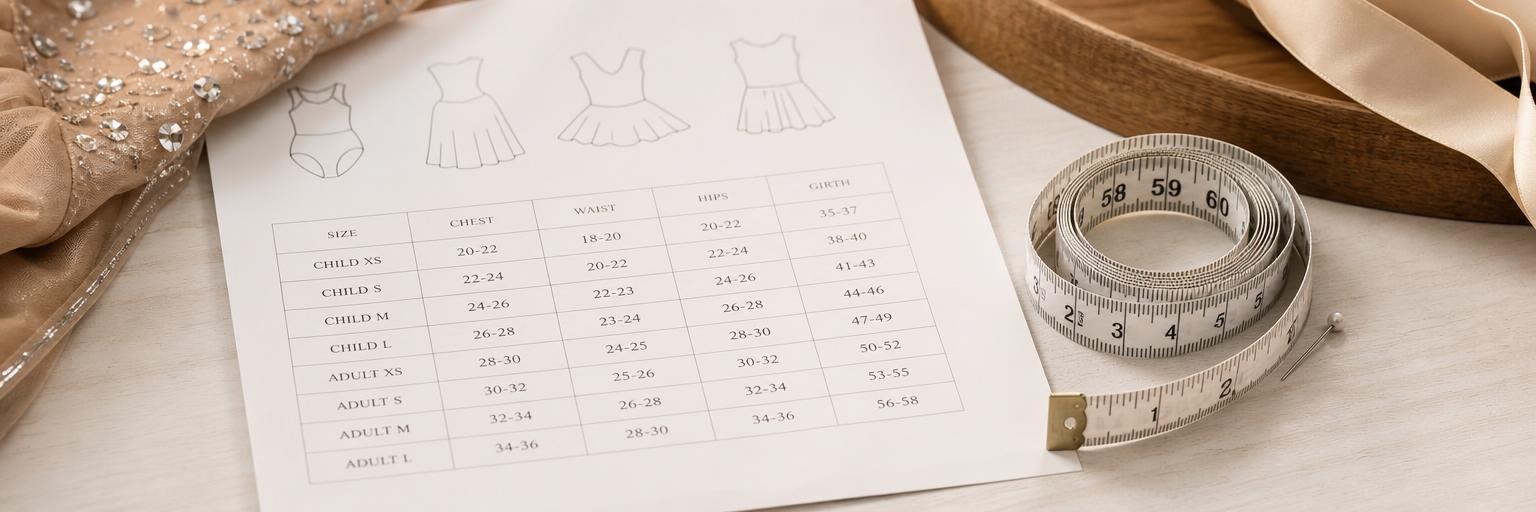
- The longer conversation, when there is time. Three things you actually believe and need to say out loud, once, this season: most dancers' bodies change a lot between 12 and 17 and that is biology not failure; the dance world has body bias and it is not her fault that the world is the way it is; costume measurements are sizing information, not a verdict on her body. (The how do I know what size dance costume to order walkthrough names the tape-and-chart steps in body-neutral terms, which is the version to read together if you and she are taking the measurement at the kitchen table together.) Say these in your kitchen, not in the car driving away from comp. Eye contact. Three sentences. Then drop it. The first time you say these things they do not land; the fifth or tenth time they become true for her too.
- What never to say (the script library). 'You are not fat.' (Validates the question's premise.) 'You are so skinny!' (Trains praise onto a body state instead of effort, kindness, or how she danced.) 'Your costume looked great even though it is tight.' (She heard 'tight,' that is what she will remember.) 'All dancers worry about this.' (Normalizes the worry; the goal is to make it smaller, not normal.) 'Your friend Anya is skinnier than you, don't worry.' (Ranks dancers by body; she heard the ranking.) 'If you just ate less you would feel better in costumes.' (Disordered eating is not a parenting strategy; this sentence has started actual eating disorders.) Save the praise for tomorrow when she can hear it, and praise the dancing, not the dancer's body.
- The hard clinician gate. Most adolescent dancers go through phases of body-conscious-ness and they come out the other side without needing professional help. Some do not. Call her pediatrician THIS WEEK if you see TWO OR MORE of these signs for longer than two weeks: restricting food at meals (skipping, picking, leaving most on the plate, cutting out entire food groups like 'no carbs' or 'no sugar'); weighing herself multiple times a day; excessive exercise outside dance (long runs, cardio, hidden stretching late at night); avoiding family meals or eating alone; loss of menstrual period for three or more months (or no period yet by age 15); always cold or always tired or dizziness; bathroom for long periods after meals; hiding food or hiding eating; sudden weight loss or sudden weight gain; constant body checking in mirrors. The phone-call opener: 'I am worried about my daughter's relationship with food and her body. Specifically, I am seeing [list the signs]. I need help knowing what to do next.' The pediatrician can run vitals, refer to an adolescent eating disorder specialist (an RD or therapist trained in this), and set up monitoring. We are not therapists; we are parents who know when to call one. Early intervention works; late intervention is harder and sometimes inpatient.
- What to do when the body comment came from inside the studio. Sometimes the dance teacher says something. Sometimes the costume coordinator does. Sometimes another dance parent does. The instinct is to brush past, but you should not. Document the comment (date, what was said, who said it, who heard it). Email the studio director, not as accusation, as concern: 'On Tuesday at 6pm rehearsal, [teacher's name] said [exact quote] to [my dancer / the team]. I am asking you to address this with the staff so it does not happen again.' Most studios will respond. Some will not. If a studio cannot or will not stop body comments on dancers, that is a transfer signal. The body-image risk of staying outweighs the cost of leaving.
- Audit your own kitchen-table language for 30 days. Your own relationship with your body shows up in every meal she eats with you. If you say 'I should not eat this' at the dinner table, she hears it. If you call yourself fat, she hears it. If you praise her on losing weight, you have trained her. If you talk about another woman's body, she is taking notes. For 30 days, stop. No body talk at the table. No diet talk in front of her. No commenting on anyone's weight. This is harder than it sounds and the absence is what she will remember. Children of mothers who never commented on bodies during adolescence have measurably better body relationships in adulthood; this is a real thing and your audit is the intervention.
- Comment on the dancing, never on the body. Watch yourself at the studio glass: do you say 'your turns are sharper today' or 'you look so good in that leotard?' Make it a rule with no exceptions. When she looks at herself in the mirror in the new comp costume and asks 'do I look okay?' the correct response is 'does it feel like a costume you can dance in?' Reframe every body question as a dance question. Train her body conversation toward how she moves, not how she looks. This rule sounds rigid; it is rigid; that is the point.
- The long term: the goal is workable, not perfect. Most dancers come out of adolescence with a complicated relationship to their body. The dancers who do best have parents who held the no-comment rule across the years (no praise on body, no critique on body, only comments on dance). They also have parents who modeled normal eating and body language at home. You will not get this perfect; nobody does. The work is the consistency, not the score. If she gets to 18 without an eating disorder and with a working relationship to food and her body, you did this right even if you do not feel like you did. If burnout, panic attacks, or 'I don't want to do this anymore' moments are showing up alongside the body-image worry, burnout, panic attacks, and quitting competitive dance is the parallel read for the related-but-different crisis. Both articles use the same clinician-gate frame: parents flag the pattern, the pediatrician sorts the next step.
Common mistakes
- Don't say 'you are not fat.' It validates the premise of the question and trains her to ask the same question of the next person until she gets the answer she wants. Reframe to feeling or to dance, every time.
- Don't praise her on a smaller body. Even once. Even as a kindness. 'You look so good, did you lose weight?' is the sentence that starts the disorder cycle in dance kids more often than any other. If she lost weight you are worried about, do not name it as praise; that is the clinician-gate signal in item 4.
- Don't comment on what she eats at meals. Not 'are you sure that is enough?' Not 'are you sure that is not too much?' Not 'wow, second helping?' The meal is hers. You set up the table; she eats. Comments train surveillance, and surveillance is what eating disorders rehearse against.
- Don't comment on your own body in front of her. Not 'I look fat in this.' Not 'I need to lose ten pounds.' Not 'I should not eat this.' She is learning what mothers do with their bodies by watching what you do with yours. The body language at your dinner table becomes the body language at hers in 20 years.
- Don't tell her to 'just ignore' a body comment from the studio. The comment landed; it cannot be unheard. Acknowledge it ('that was not okay for them to say to you'), address it (email the director), and move it off her shoulders ('that is mine to handle, not yours'). The 'just ignore it' shortcut teaches her to absorb body comments silently for the rest of her life.